

-
BALTIC PRINTMAKERS NETWORK MEETING & CONFERENCE
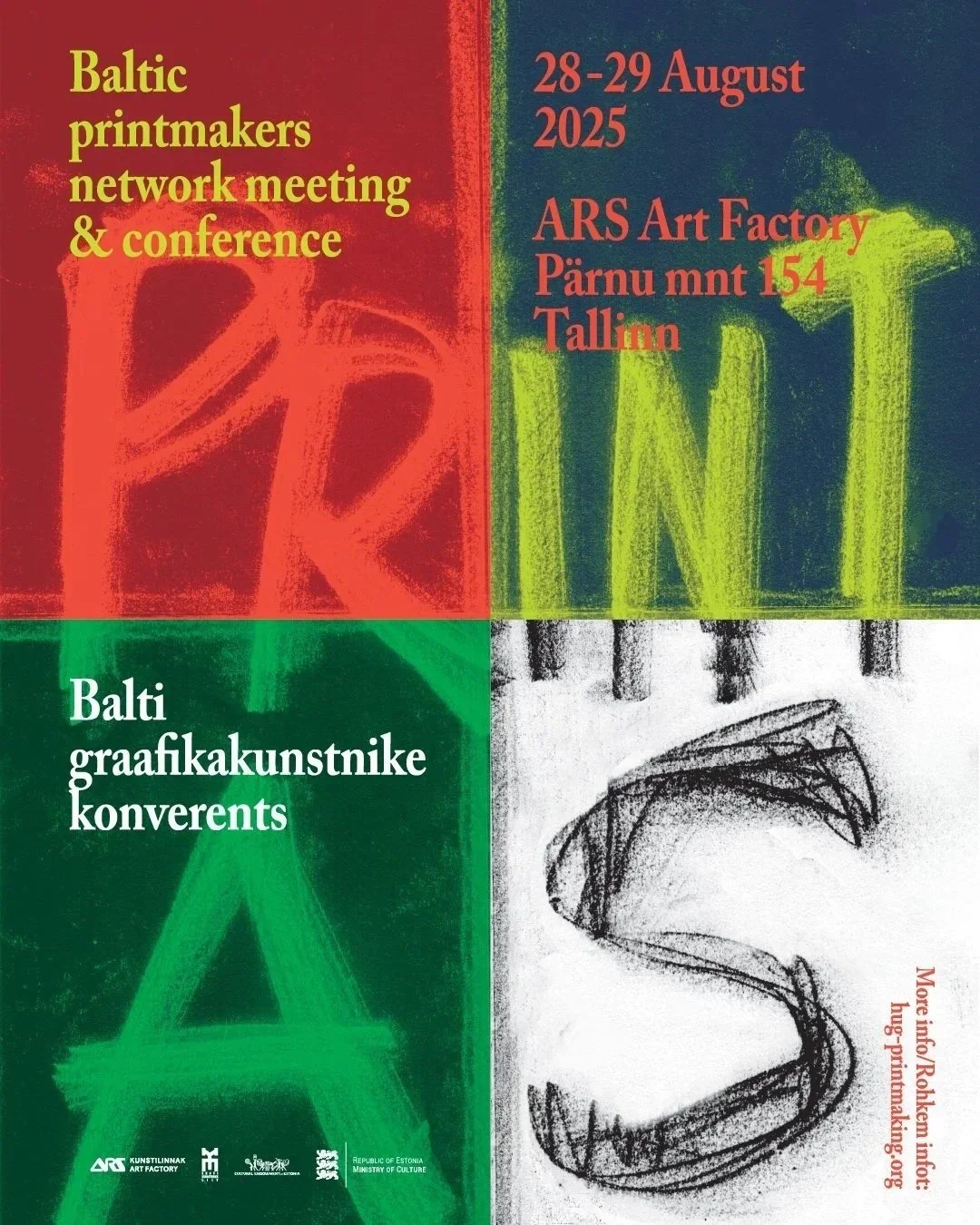
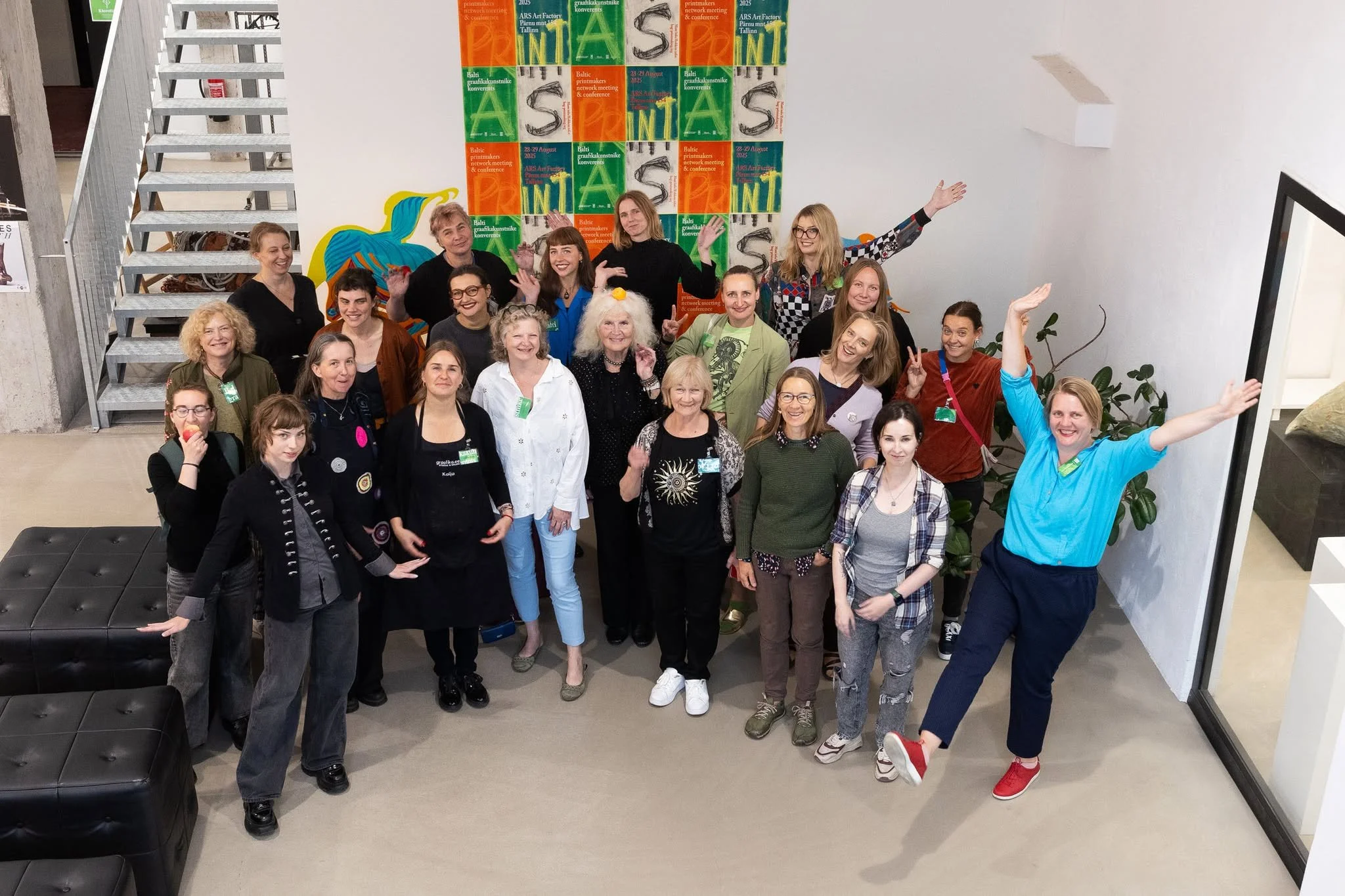
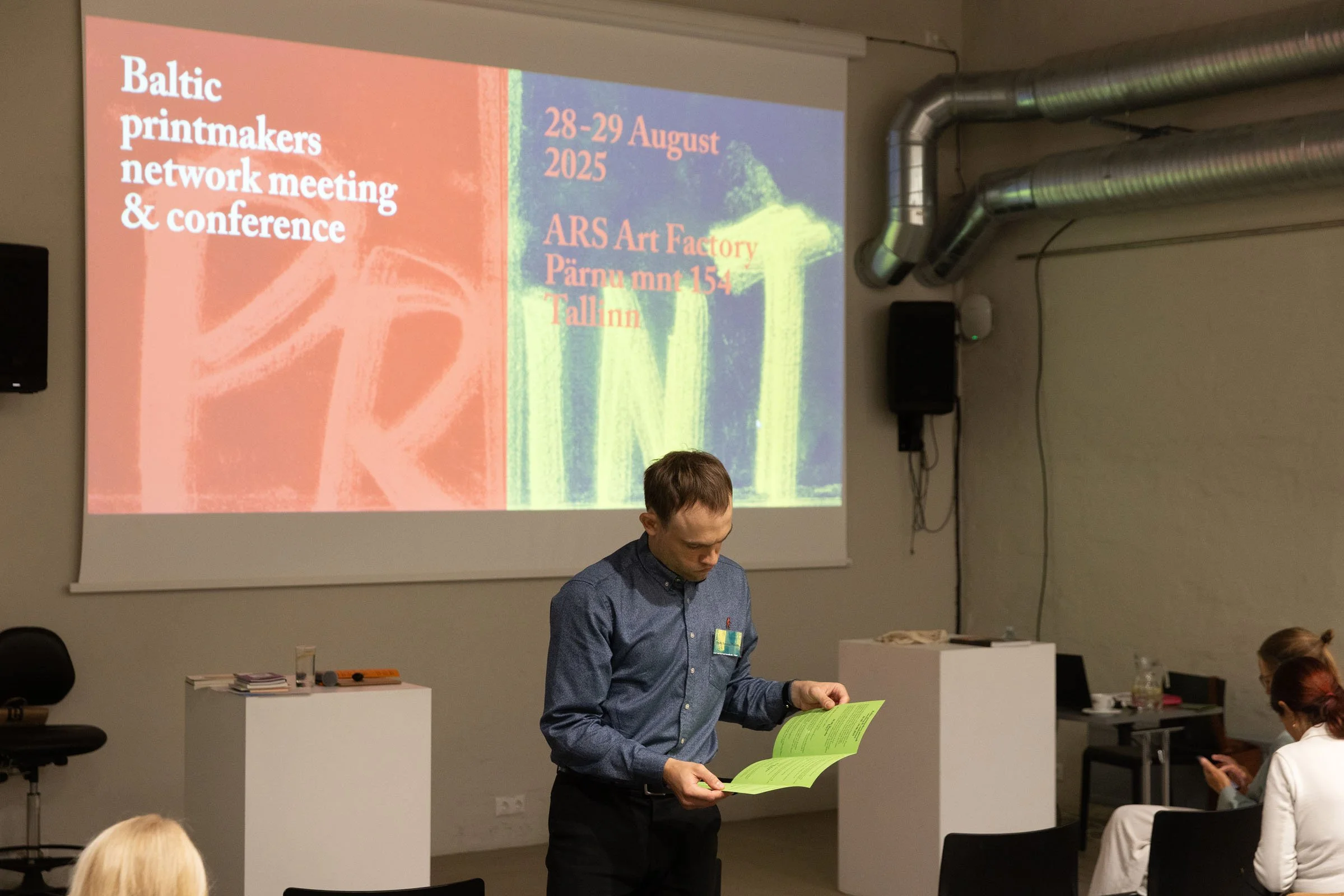
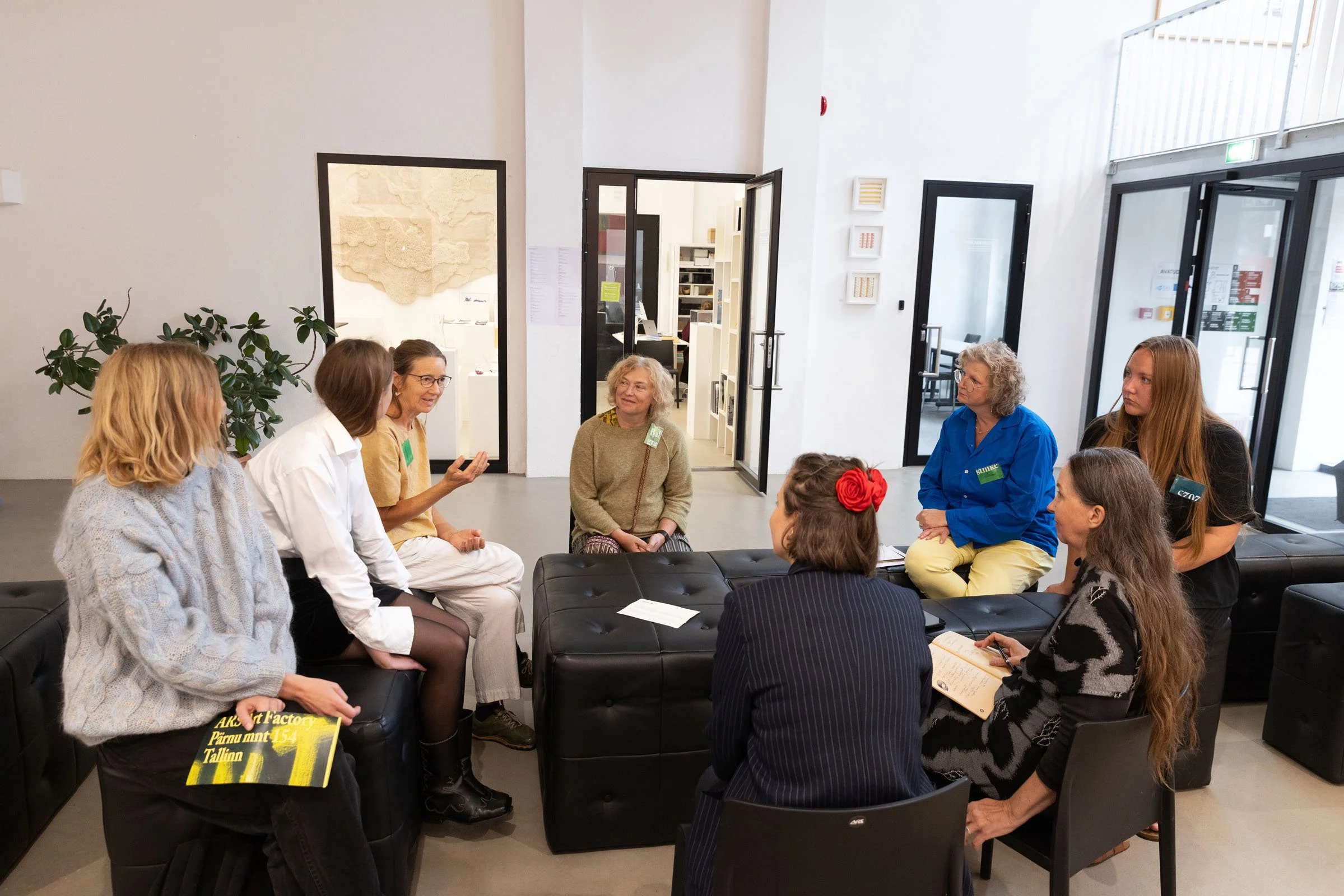
28.08–29.08.2025We warmly invited printmakers, artists, and members of printmaking communities from across the Baltic region to join us for an inspiring gathering in Tallinn. This unique conference was dedicated to exploring the materiality of printmaking today and fostering dialogue within the vibrant Nordic–Baltic printmaking community.
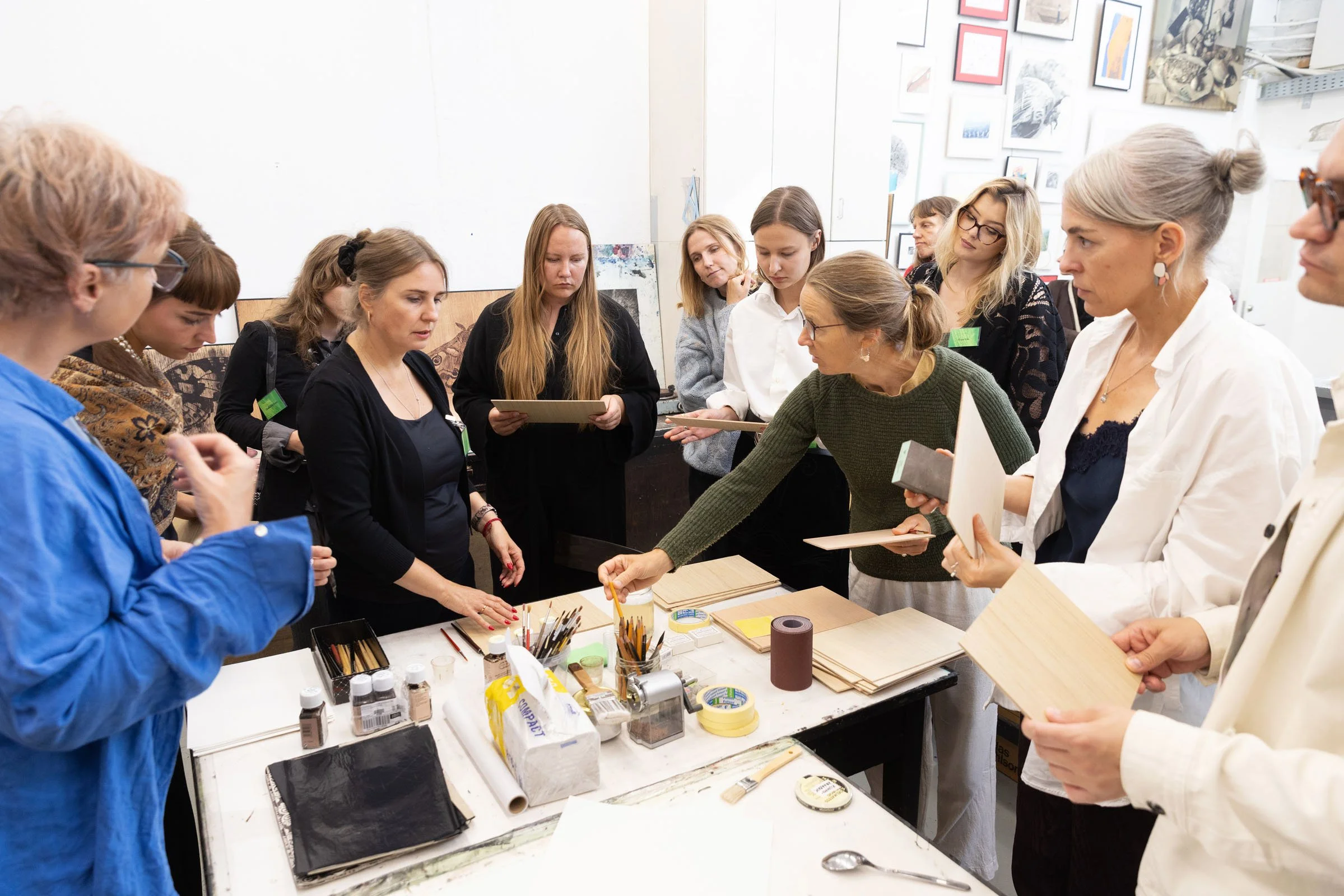
Through insightful discussions and hands-on workshops, participants delved into environmentally conscious, sustainable, and non-toxic printmaking techniques. Together, we celebrated the distinctive qualities of printmaking processes and reflected on their role in shaping contemporary artistic practices, while addressing ecological responsibility within the field.
The event was organised by HUG, an initiative dedicated to developing and strengthening printmaking communities across the Nordic–Baltic countries.
-
Mokulito, Scagliola and Other Fruits of the Tree of Great New Printmaking
Over the past half century, the history of Estonian printmaking has been eventful. When the Tallinn Print Triennial was launched in 1968, our capital soon became a beacon in the art world of the Soviet Union, as we consciously oriented ourselves towards Western art, which distinguished us from the more traditional printmaking of Latvia, Lithuania and even more so from the other Soviet republics of the time. In 1989, the Print Triennial became an international event, but for a while longer, Estonian artists still had a fairly high chance of being selected for the triennial.
The triennial’s role as a driving force kept our art at a high level, because most artists worked very actively to prepare for the competition held every three years. There was a great sense of competitiveness within the Experimental Printmaking Studio – later the Printmaking Hall (Graafikakoda) – where colleagues would see each other’s works whether they wanted to or not. Working together provided a sense of support, catalogues received from abroad were passed round, and discussions on art topics were held. Such cooperation continued until the end of the 20th century and even into the beginning of the new millennium, although representatives of the older generation were becoming fewer and fewer. New graphic artists also emerged who considered themselves the students of the masters of the previous century.
But printmaking changes with time: not only printing techniques, but also colours, types of paper and technical tools. Conceptualism holds an elevated position in contemporary art, also influencing printmaking. Thus, graphic art is both new and old, because it is always associated with techniques. Graphic artists make printing plates, which are the cornerstones of their work. The prints from the plates themselves are (traditionally) considered artworks and are displayed at exhibitions.
The north and the south
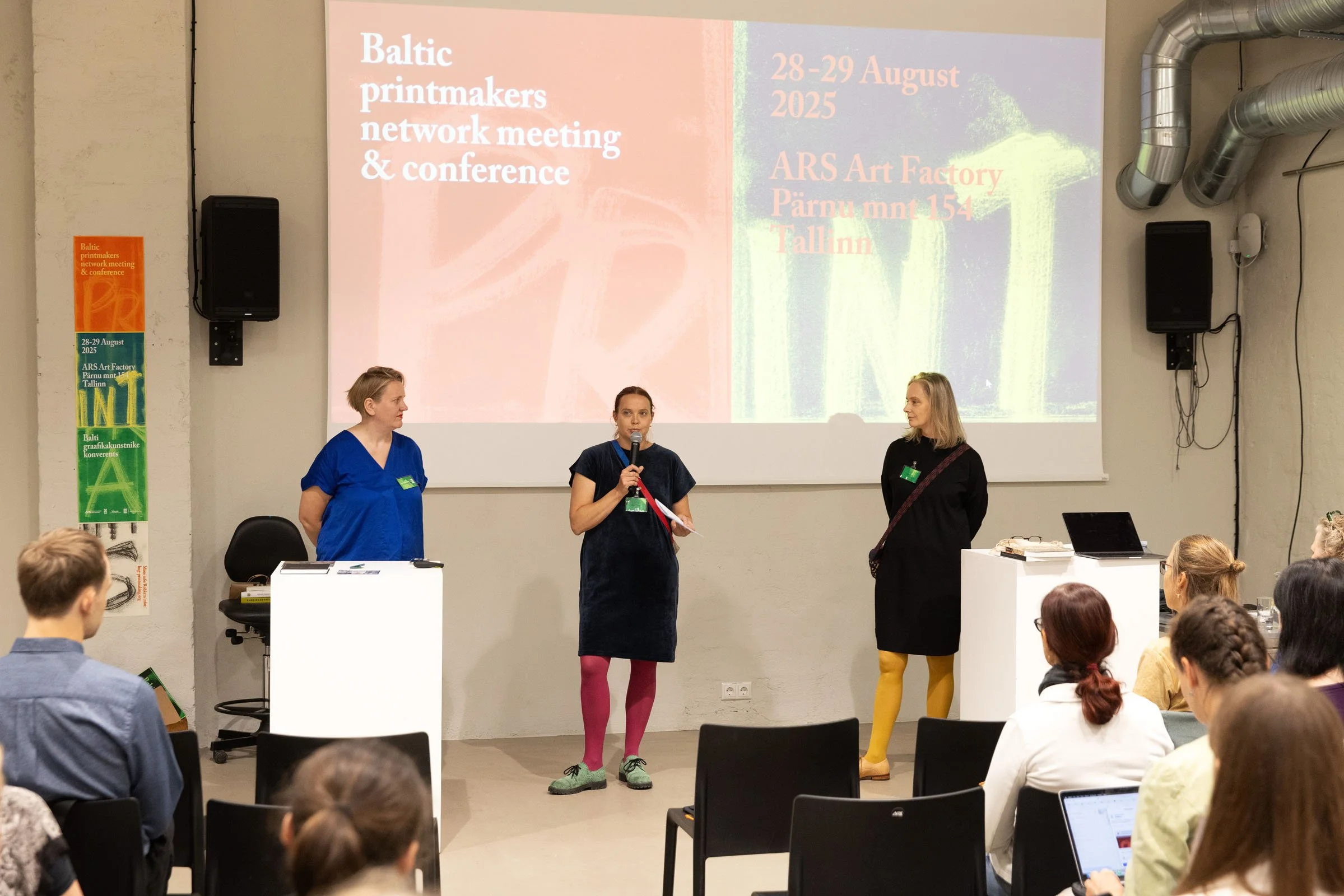
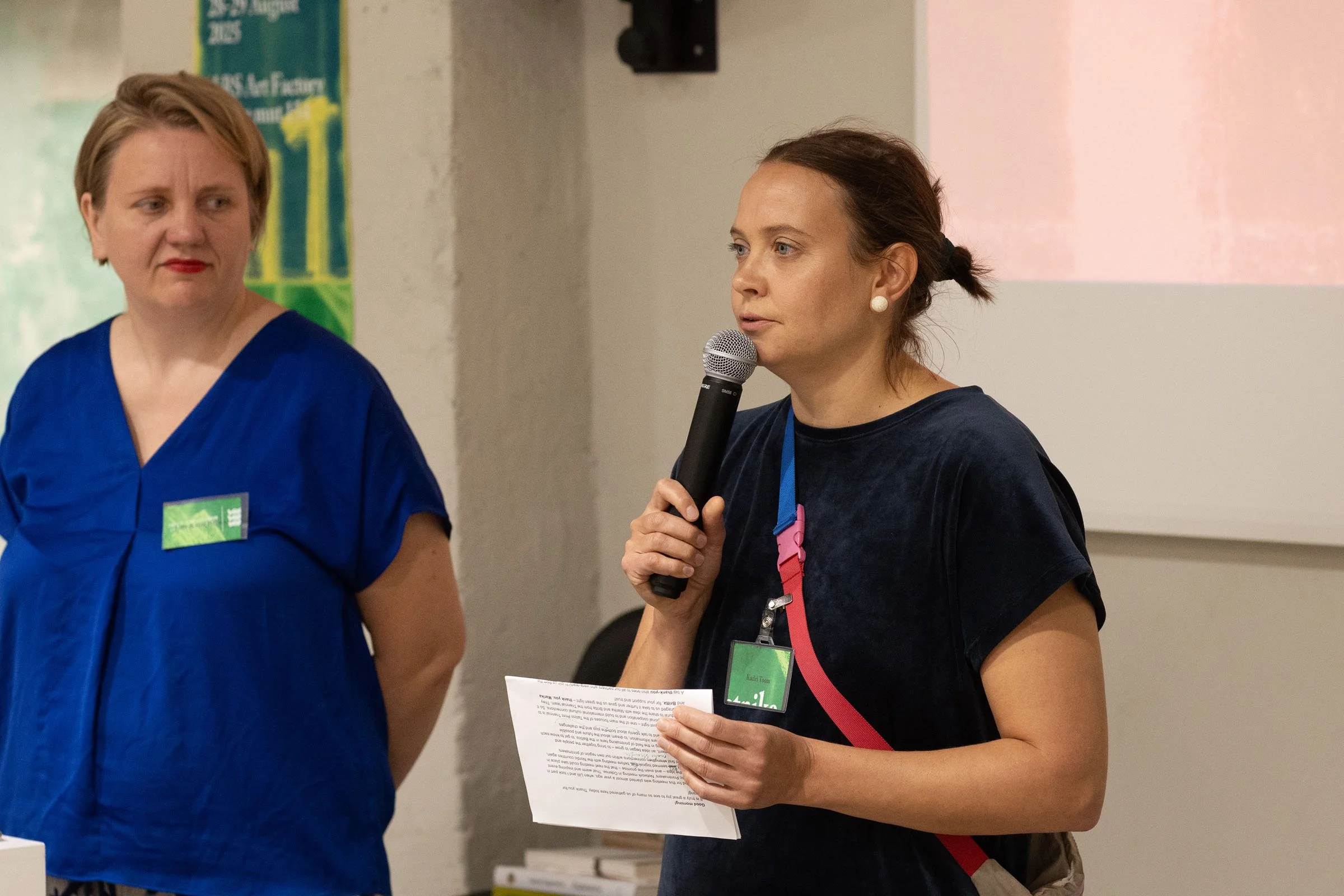
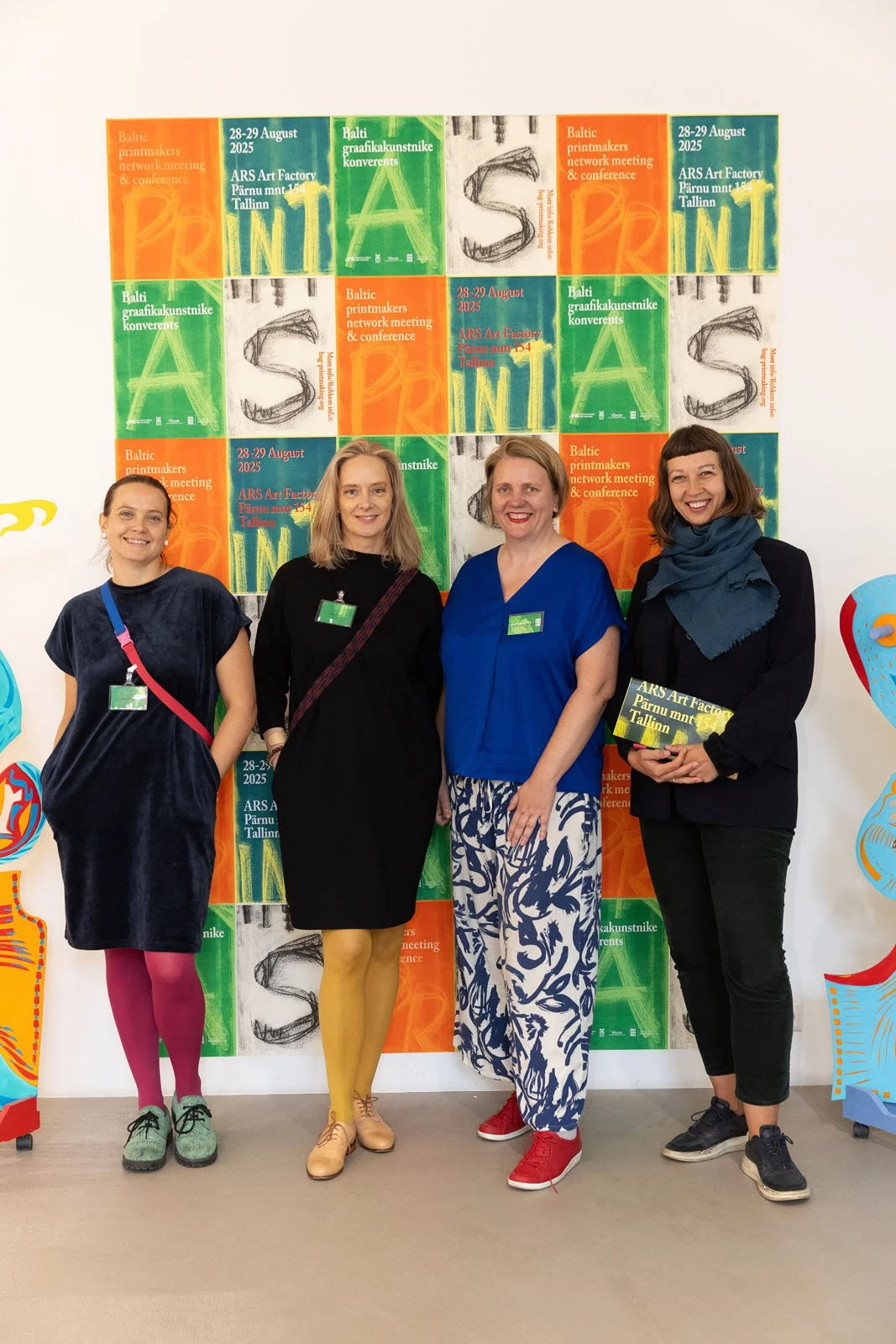
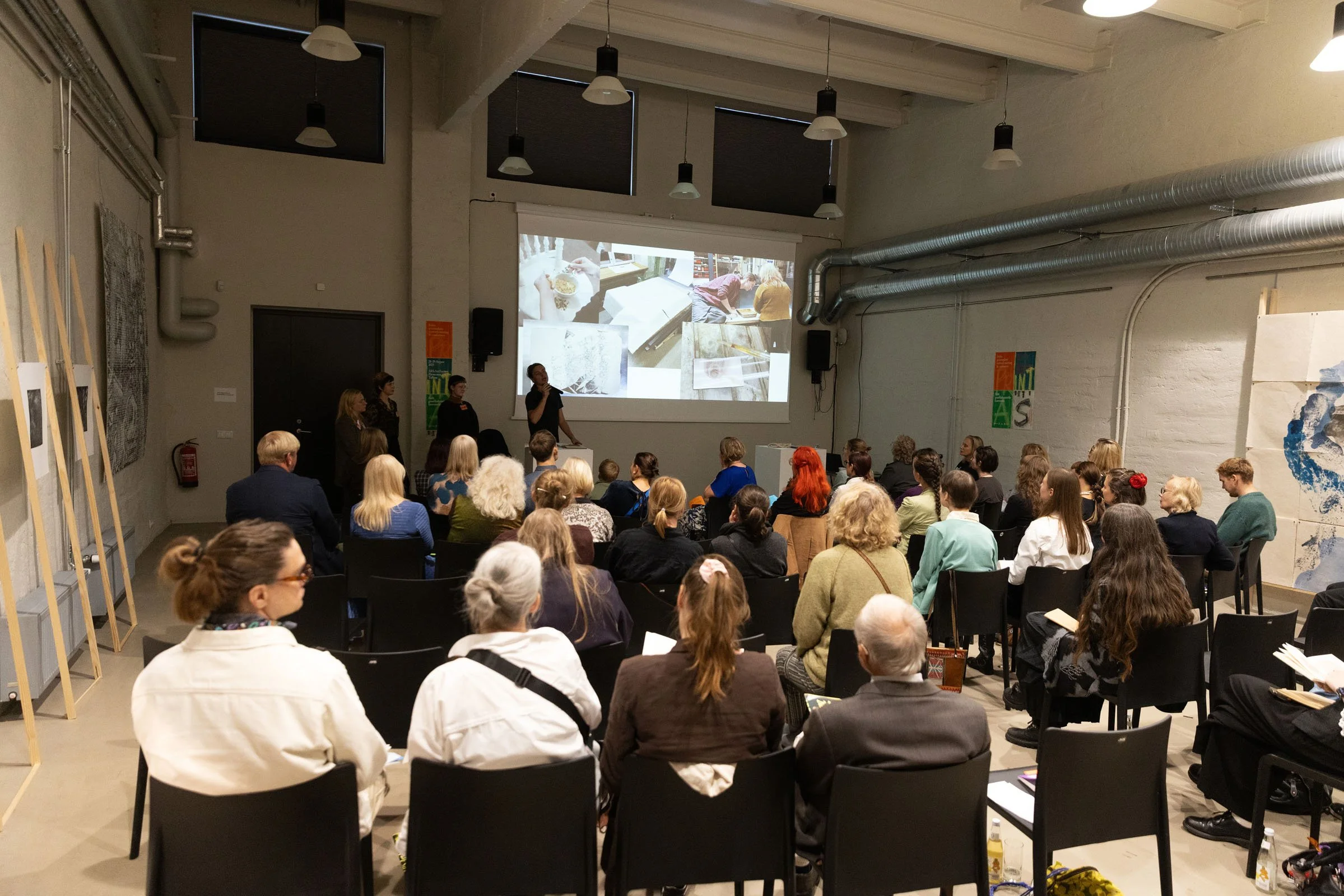
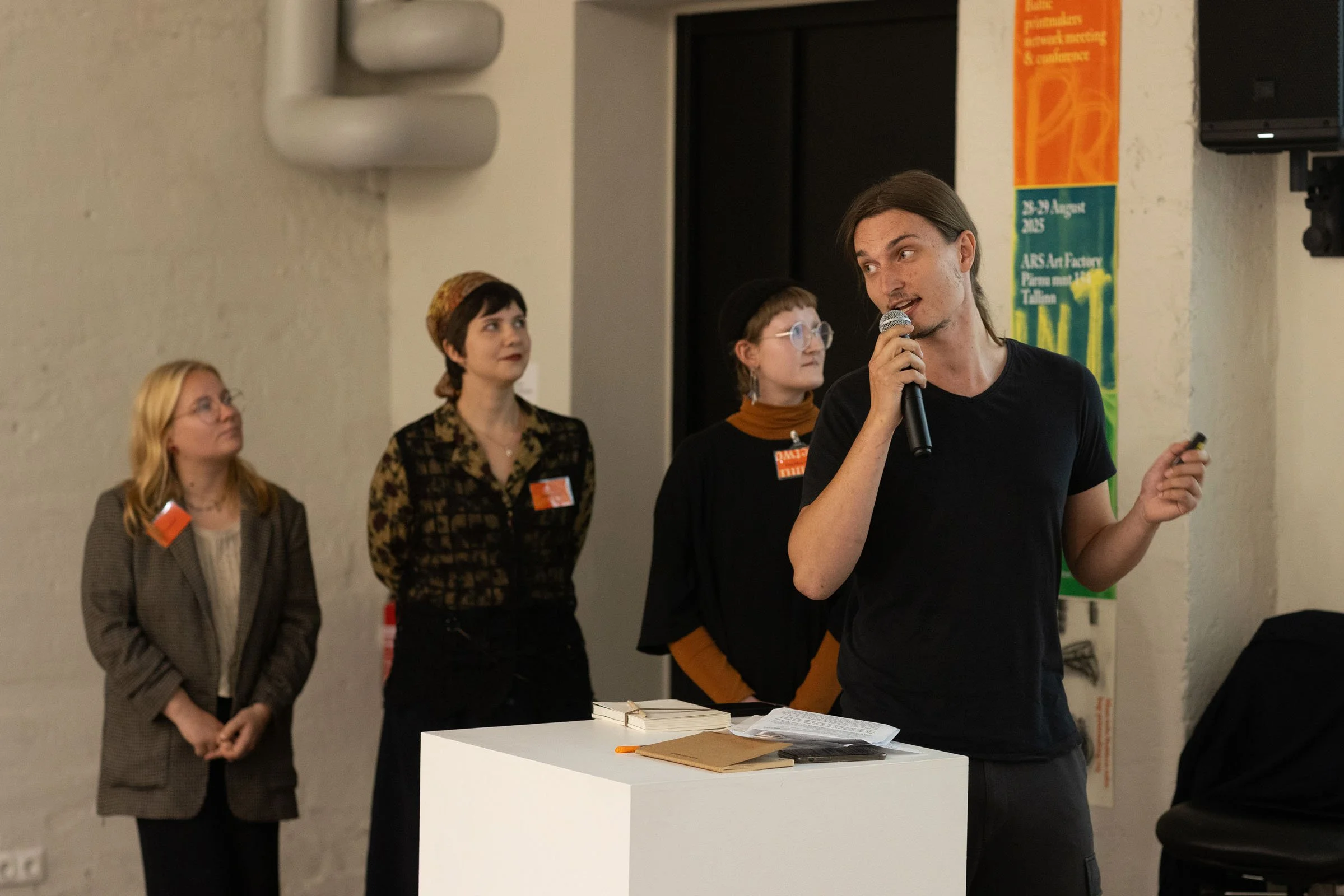
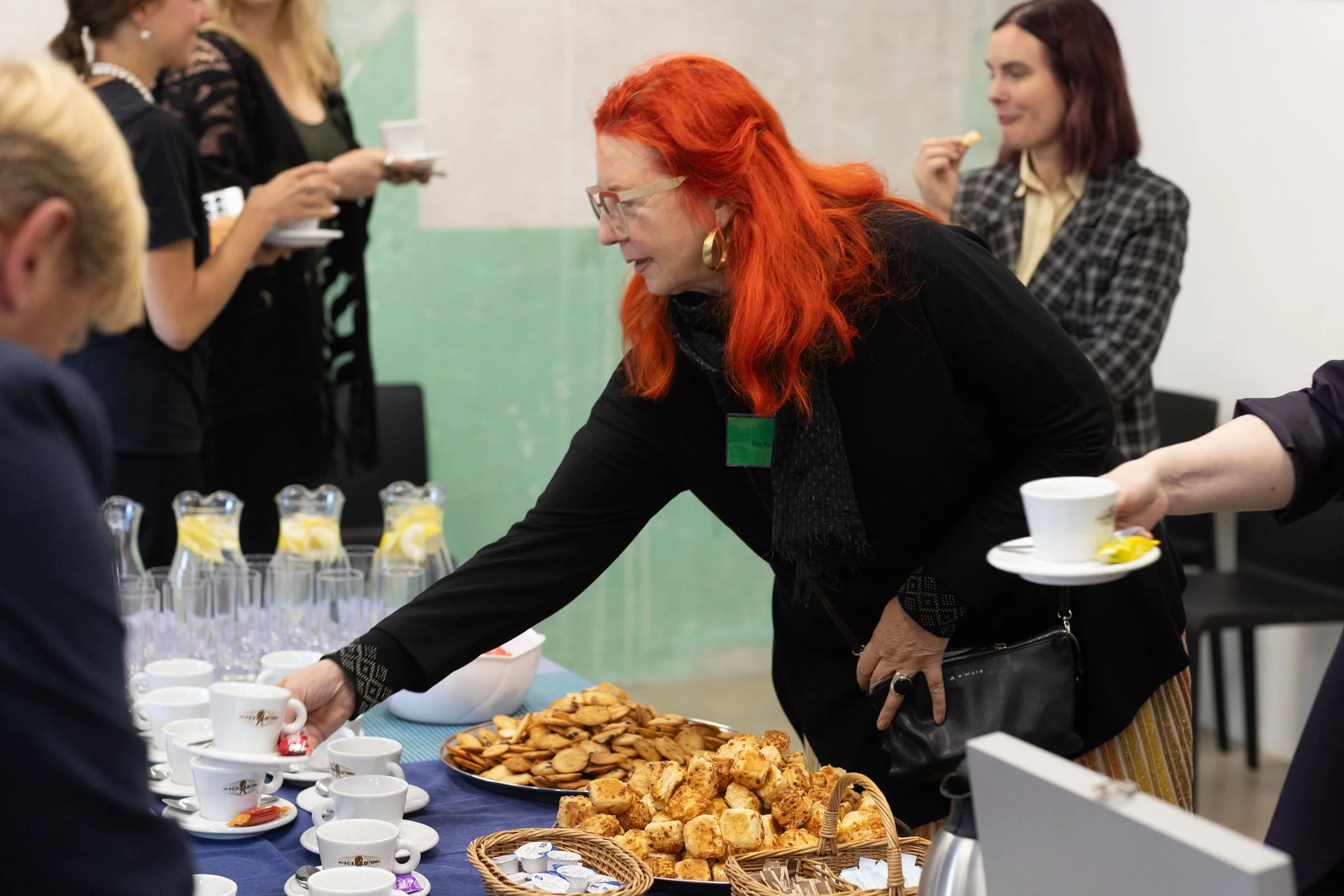
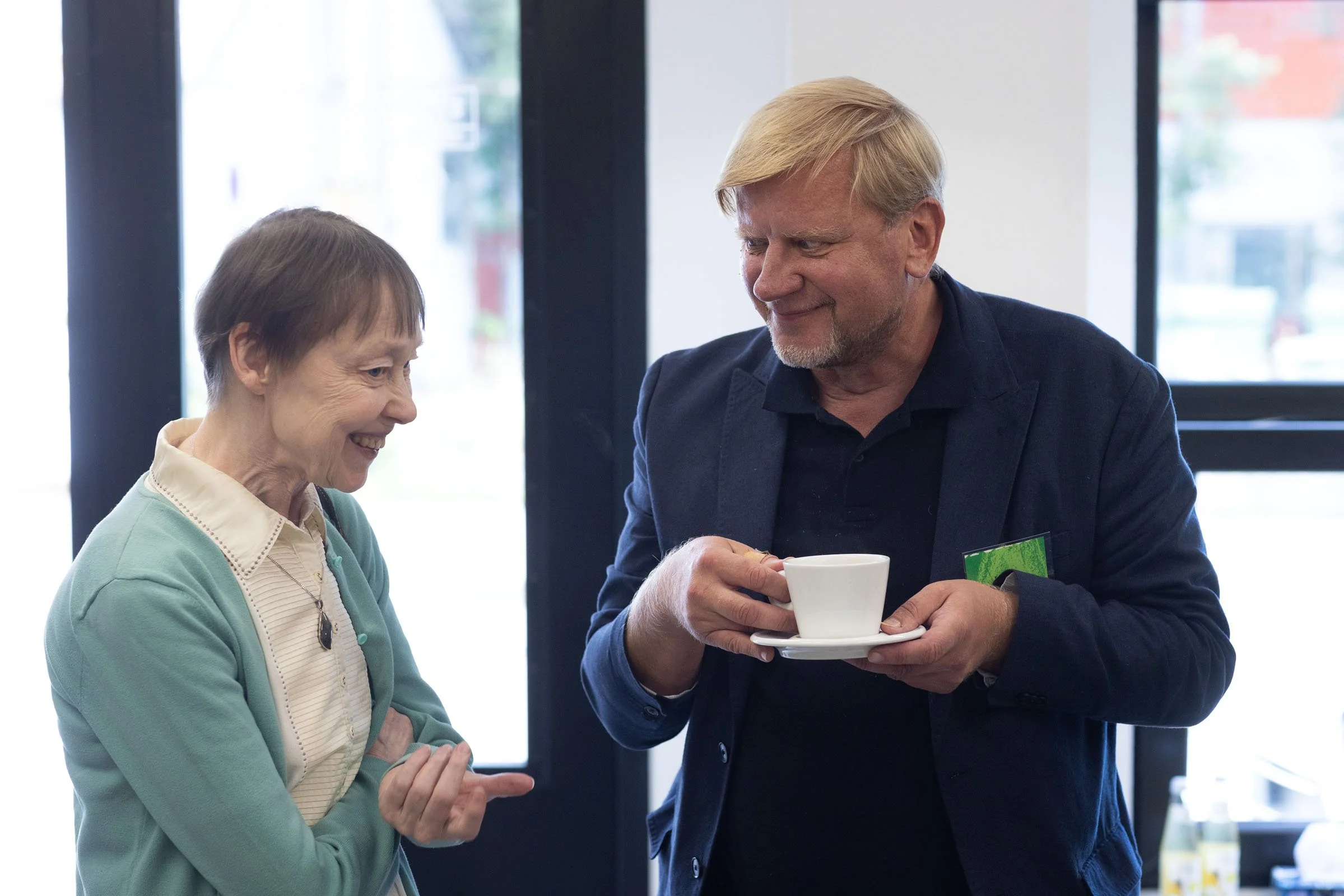
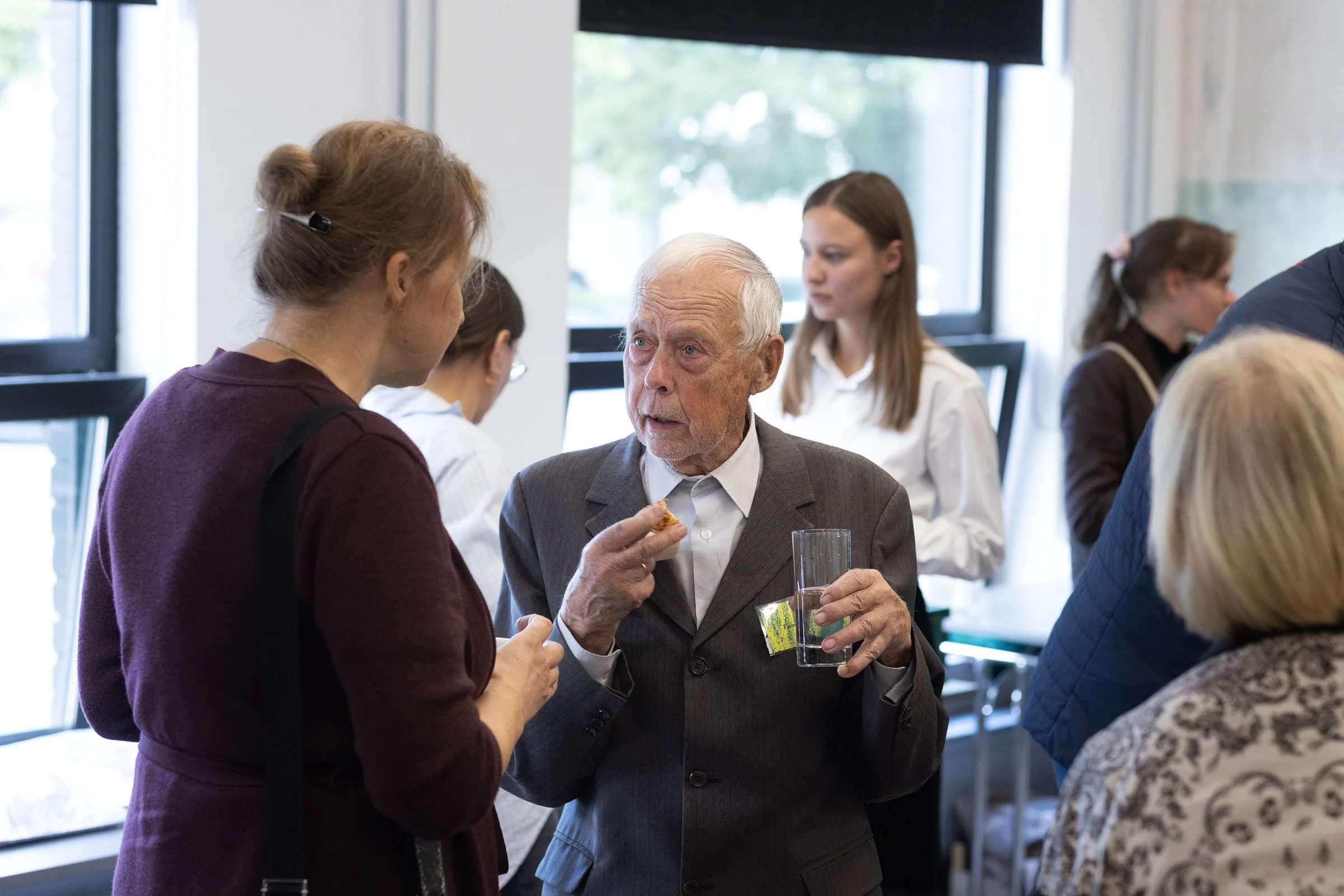
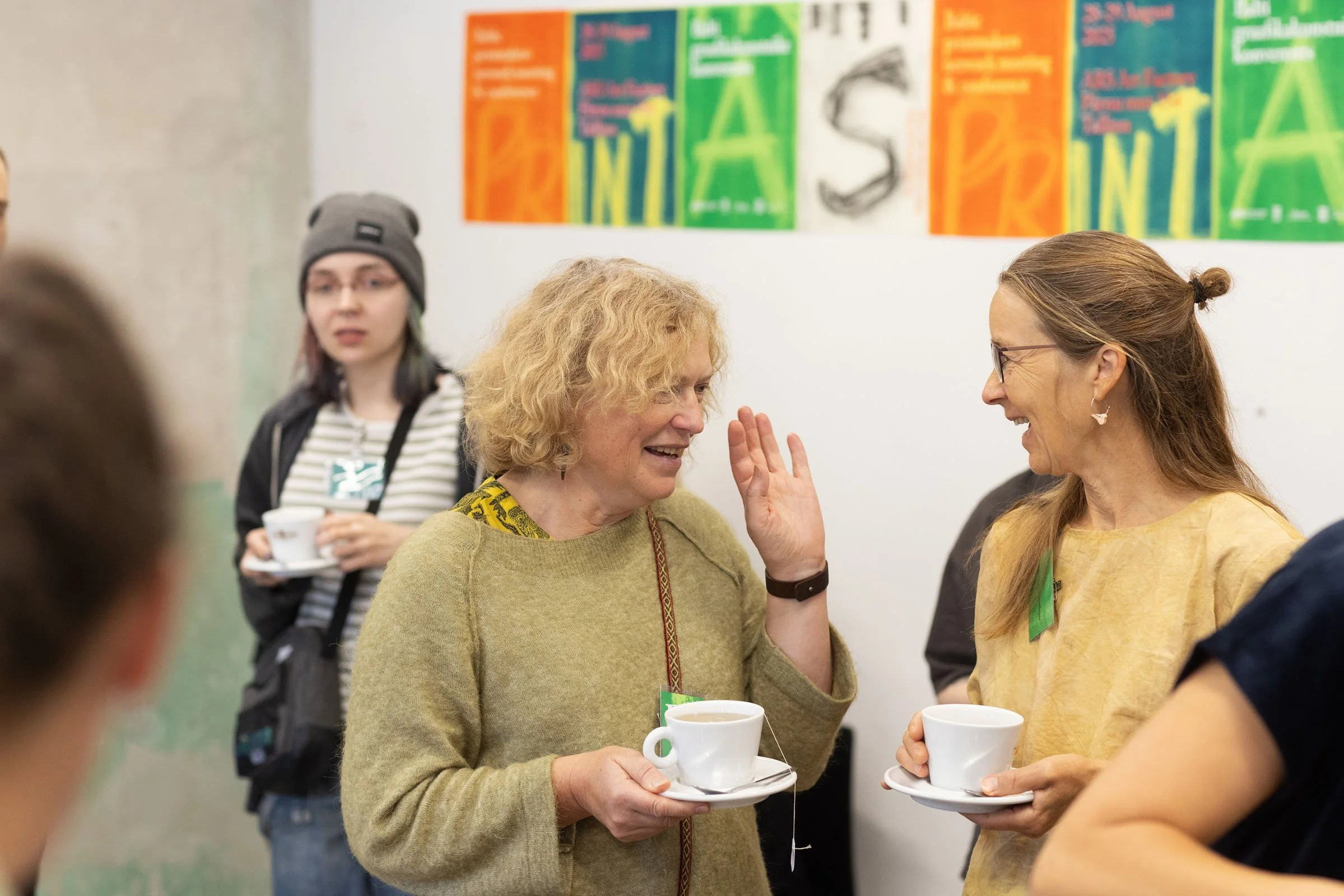
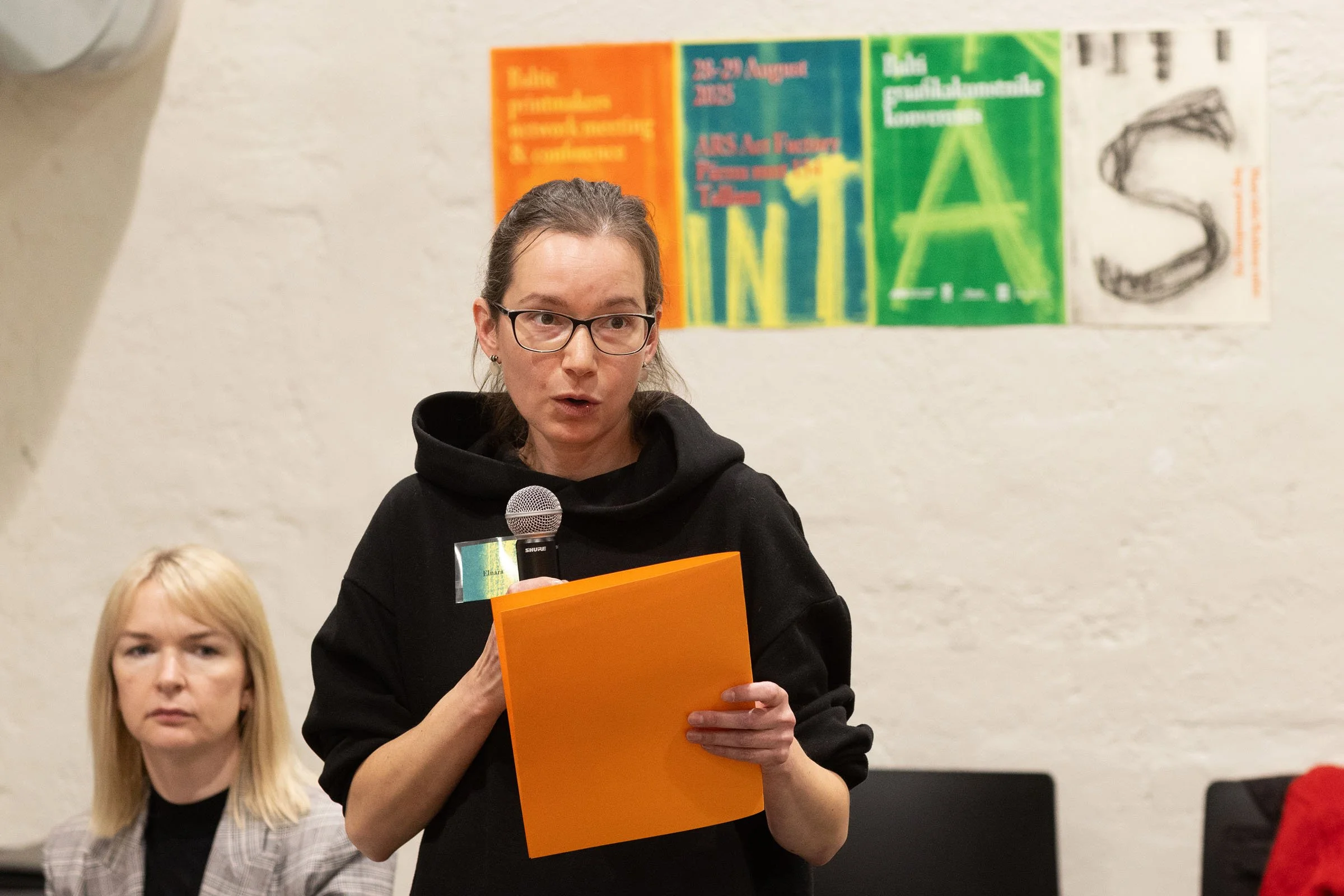
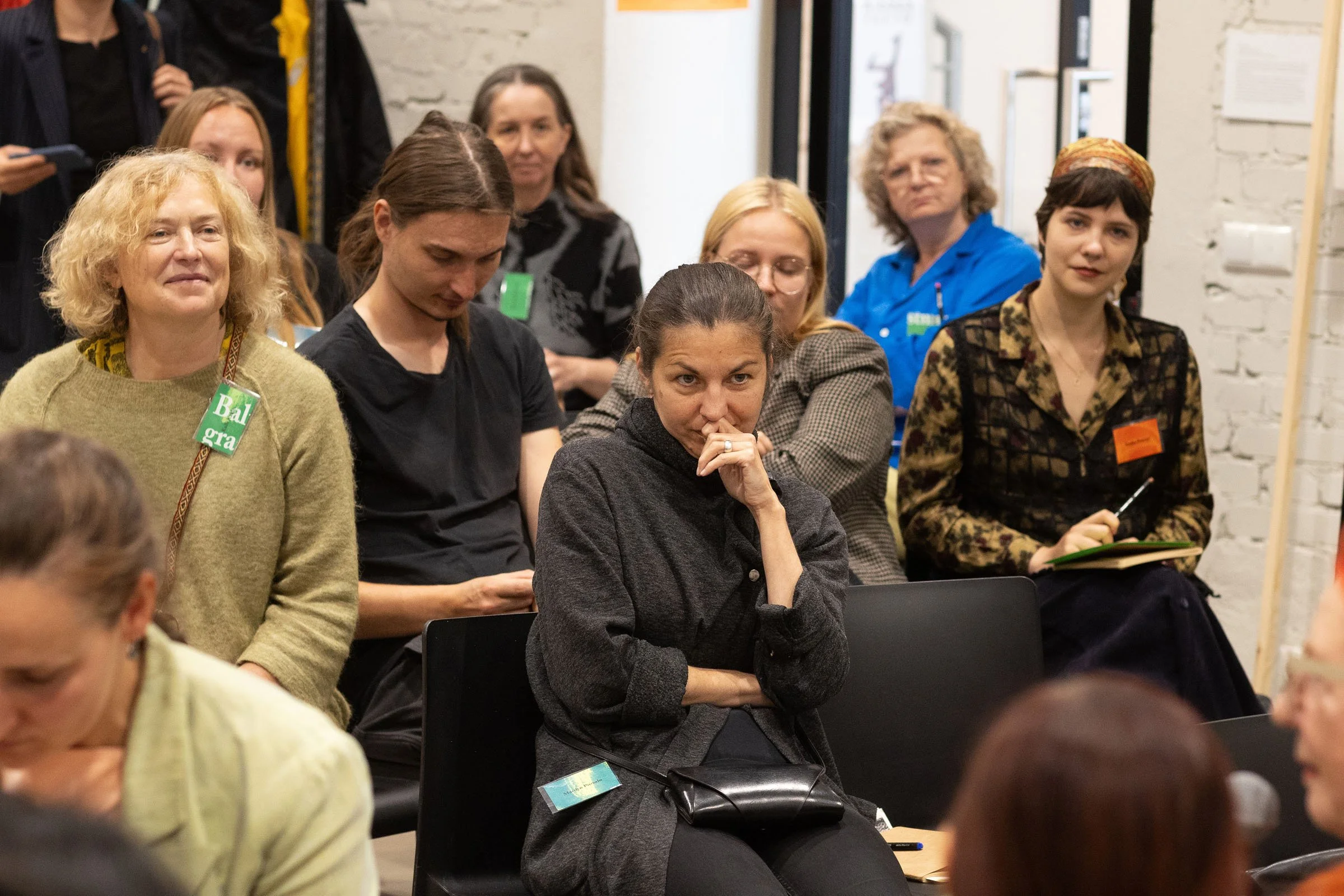
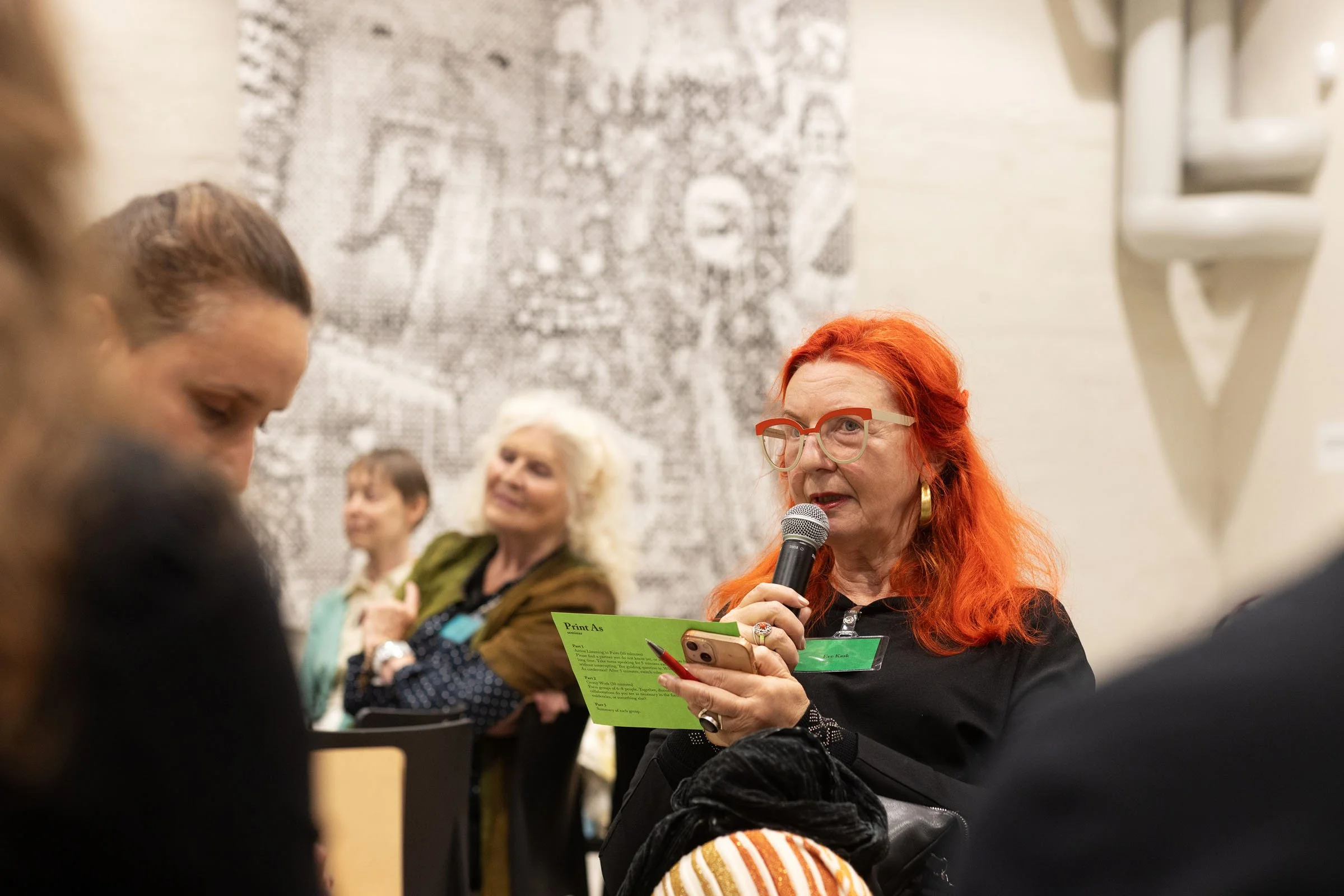
These changes, the current situation and the relationship between the new and the old were discussed at the conference “Print As” held on 28 and 29 August 2025 at the ARS Art Factory and organised by the NGO Hea Uus Graafika (abbreviated as HUG and translated as Great New Printmaking). Since the working language was English, the meaning of this abbreviation did not go unnoticed. The poster read: “Baltic printmakers network meeting & conference”. In addition to the Baltic countries, the Nordics were also involved, and they have played an important role as good cooperation partners for Estonian printmakers for decades. The initiators of this very necessary undertaking were the printmakers Liis Tedre, Kadri Toom and Lilli-Krõõt Repnau, all of whom were born about ten years after the first Print Triennial was organised.
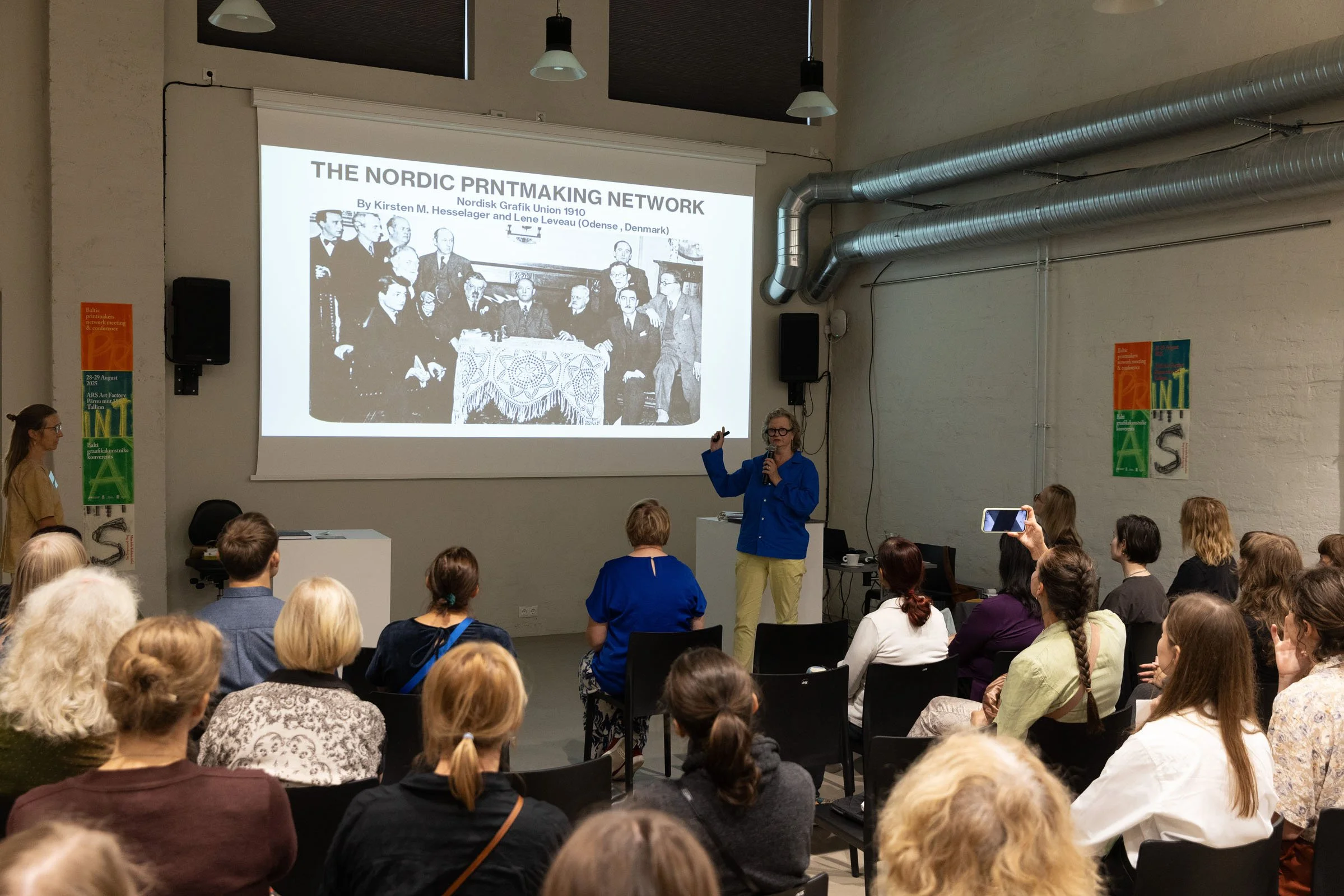
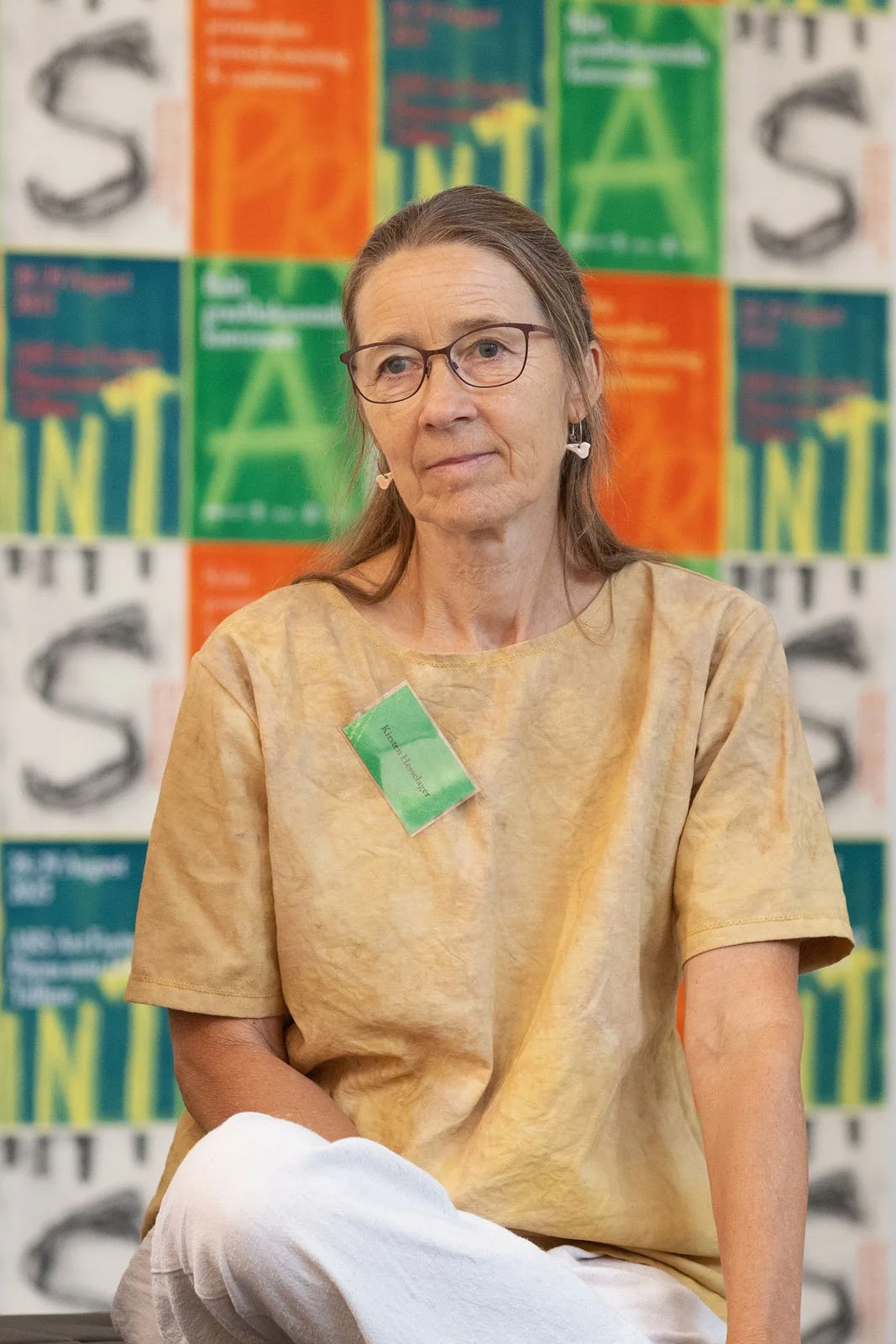
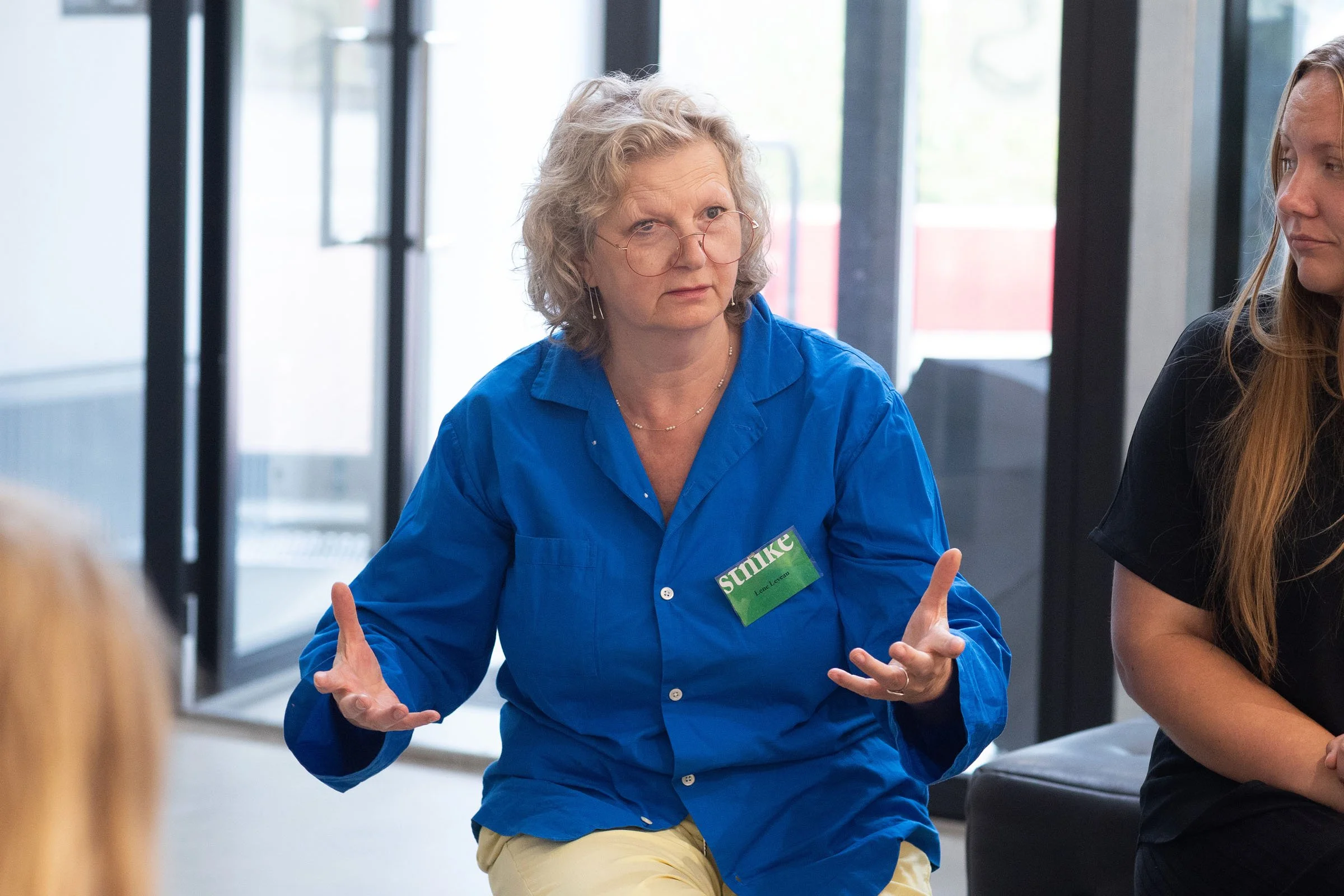
Lene Leveau, the director of the Funen Printmaking Studio in Odense, Denmark, and the artist Kirsten Muchitch Hesselager were invited to speak at the conference, representing the Nordic countries. The Nordic Printmaking Network (Nordisk Grafik Union) was founded in 1910 with the aim of creating contacts between the artists of these countries and developing together. This grew into a dense network that now connects printmaking organisations operating in these countries. The speaker emphasised that the goal of the network’s activities is not profit, but voluntary work and good results in art. The member countries meet regularly, most recently in 2024 in Odense. Information and experiences are exchanged and knowledge about new techniques is shared. In the Nordic countries, graphic artists have many joint workshops. For example, in Sweden they are called artists’ collective workshops (konstnärnernas kollektivverkstäder). Odense also has a studio, a residency, a gallery and a shop. A very serious atmosphere has historically developed in this unique ecosystem.
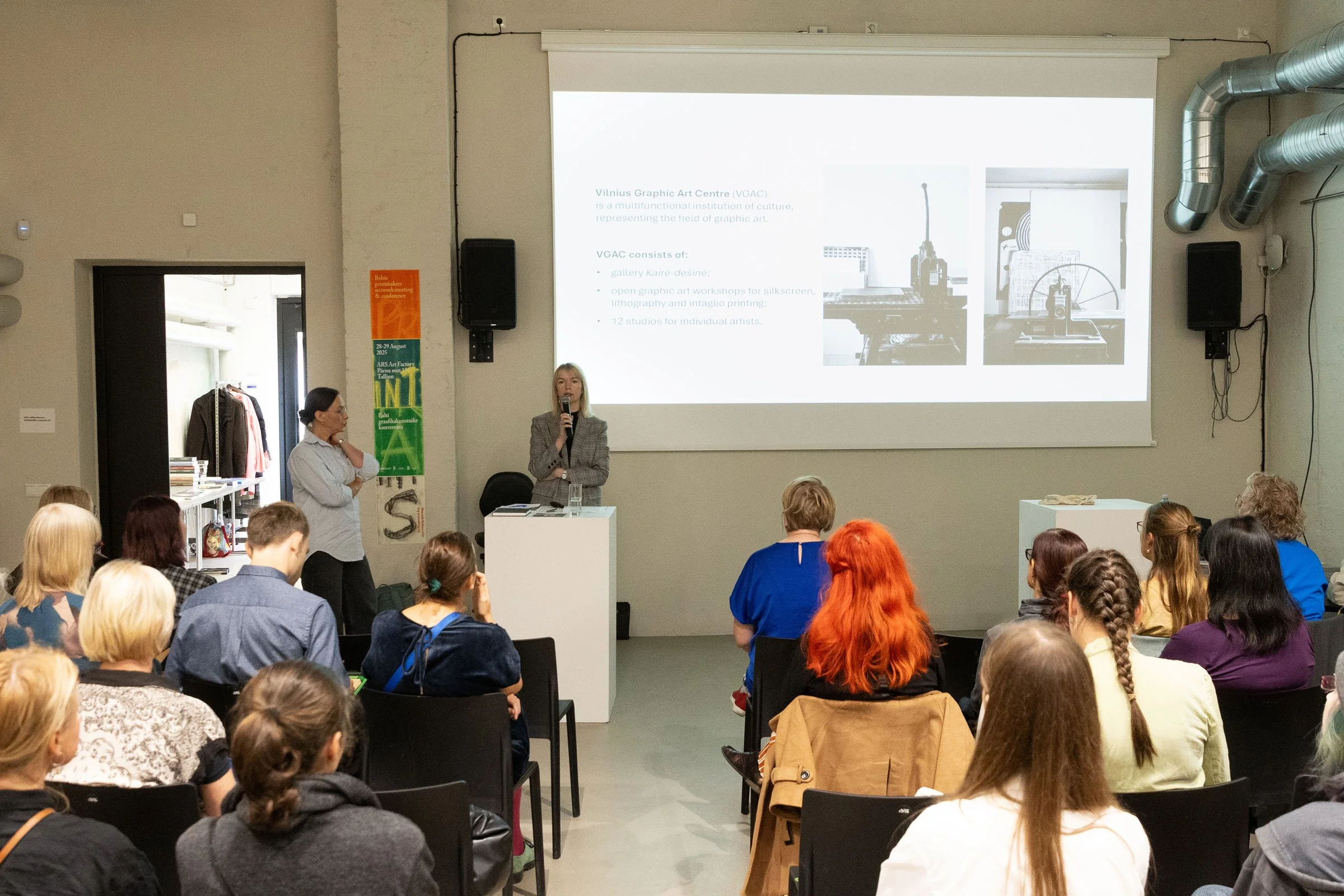
In Lithuania, the heart of printmaking is the Vilnius Graphic Arts Centre (Vilniaus grafikos meno centras), whose active undertakings automatically make one think that Lithuanian printmakers are currently in a somewhat better situation than their Estonian colleagues, because the aim of this organisation is directly to support the activities of graphic artists in any way possible. The Lithuanians Jurga Minčinauskienė and Kristina Kleponytė-Šemeškienė spoke about exhibitions, participation in international cooperation projects, publishing catalogues, research-based art books and monographs, and art programmes for adults and children. The gallery Kaire-dešinė, which has been operating at the centre since 1995, organises curatorial and solo exhibitions, as well as shows about illustration, young artists and artist books by Lithuanian and foreign authors.
Drawing exhibitions by Lithuanian artists have been taking place since 2006. The presenters also circulated valuable publications among the public: for example, The Body. Graphic Art 1980–2013, Lithuanian posters during World War I and II, exhibition catalogues of drawings by the graphic artist Petras Repšys and the painter Povilas Ričardas Vaitekunas, monographs on the graphic designers Telesforas Kulakauskas and Antanas Kazakauskas, and on the illustrator Kestutis Kasparavičius, etc.
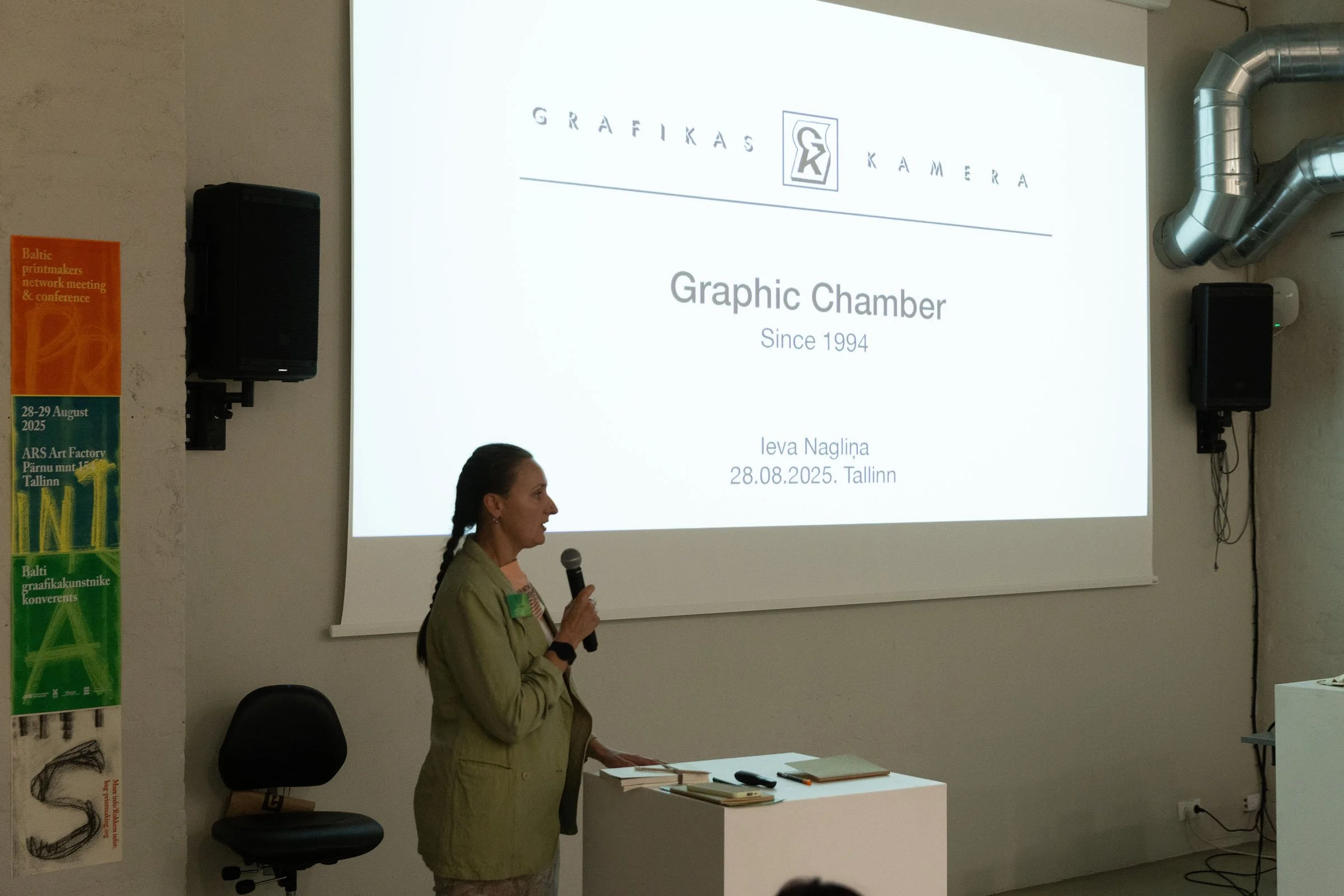
Ieva Naglina, the head of the Latvian Chamber of Graphics (Grafikas Kamera), similar to the Vilnius Graphic Arts Center, spoke about the institution she founded in the 1990s with the aim of helping artists during the transformations of the era, because they were facing commercial challenges. The Latvian Chamber of Graphics organises exhibitions, conferences, excursions to the Tallinn Print Triennial, etc. They also have their own Kammergalerija, where exhibitions of smaller prints have been held, e.g. by the Latvian artists Imants Krepics, Gundega Evelone, et al, as well as by the Finnish artist Niina-Anneli Kaarnamo, who studied at the Estonian Academy of Arts, and the Estonian Toomas Kuusing. Lectures are held and workshops are organised on graphic techniques and skills in using photography and computers. The Chamber’s prints collection was founded during the Soviet era.
A roof over your head?
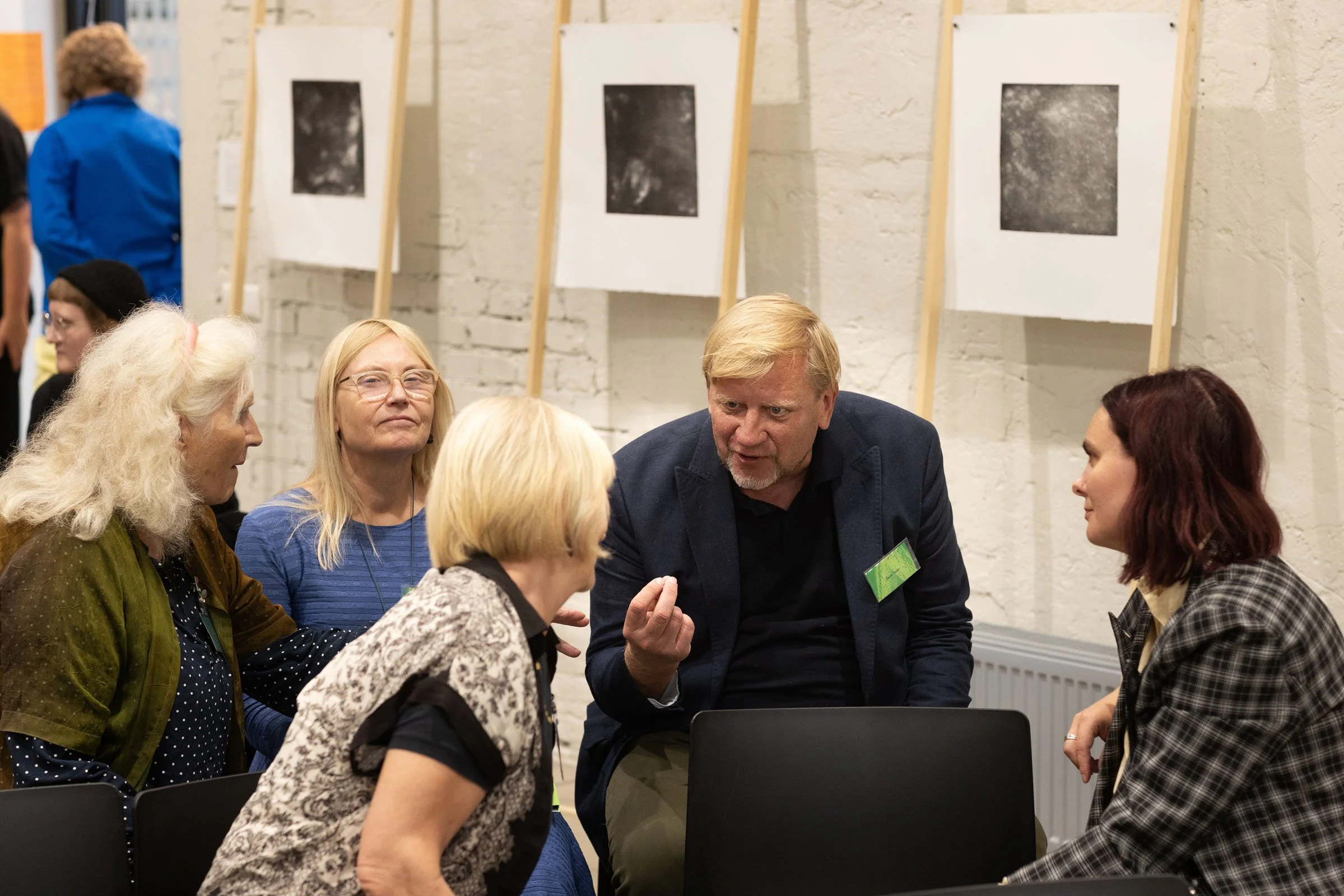
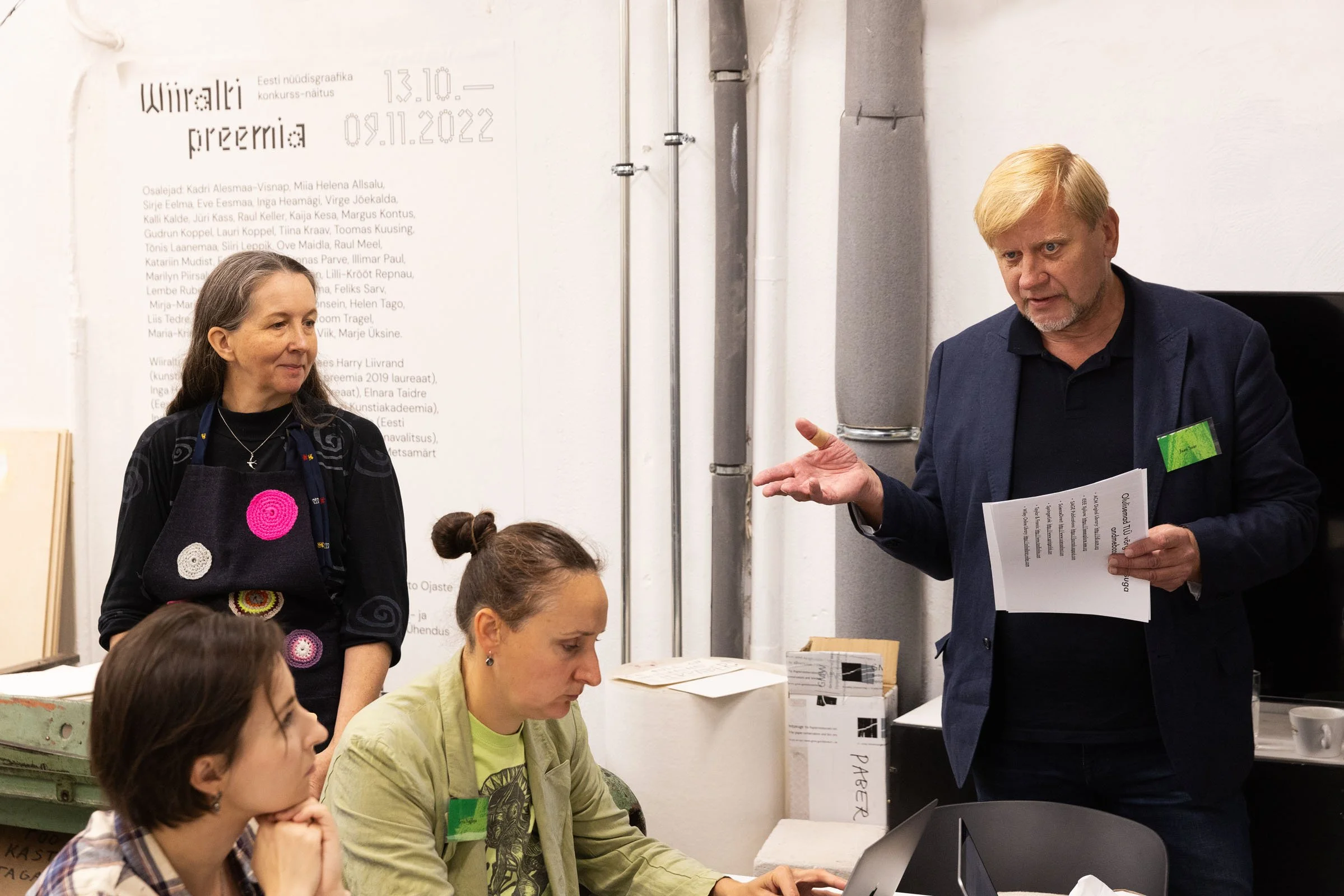
Estonia currently does not have a supportive umbrella organisation as in the other Baltic countries. The Printmaking Hall is for actually printing works, but since the master printmaker is not present every day, a place for active communication, working and even drinking coffee together has disappeared. Works can only be displayed at the Eduard Wiiralt Art Award exhibition. The Print Triennial no longer offers our artists almost automatic participation. The activities of the Printmaking Hall and the Tallinn-based Association of Estonian Printmakers were introduced at the conference by Jaan Saar, the president of the association, and the board member Elle May Palumäe.1
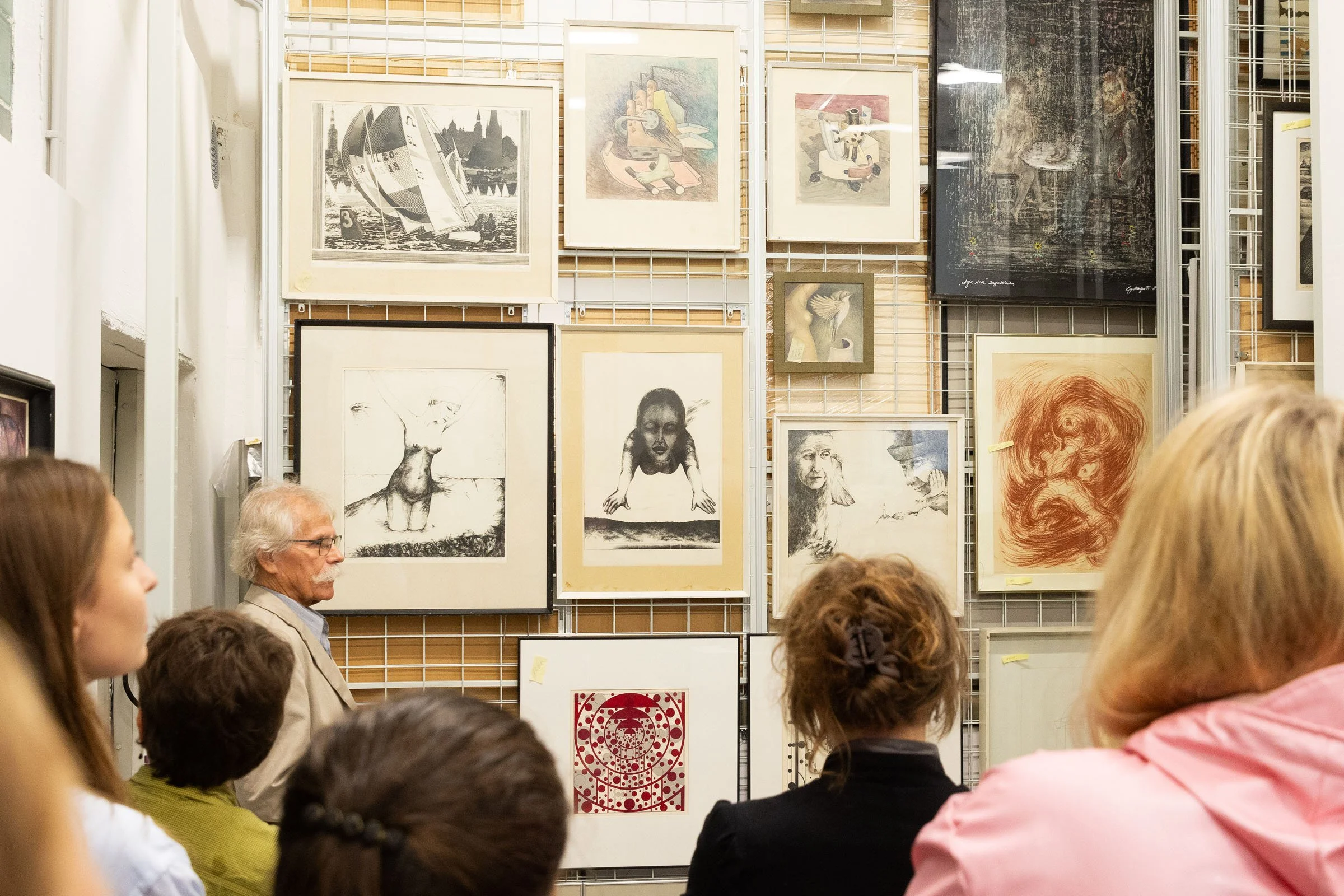
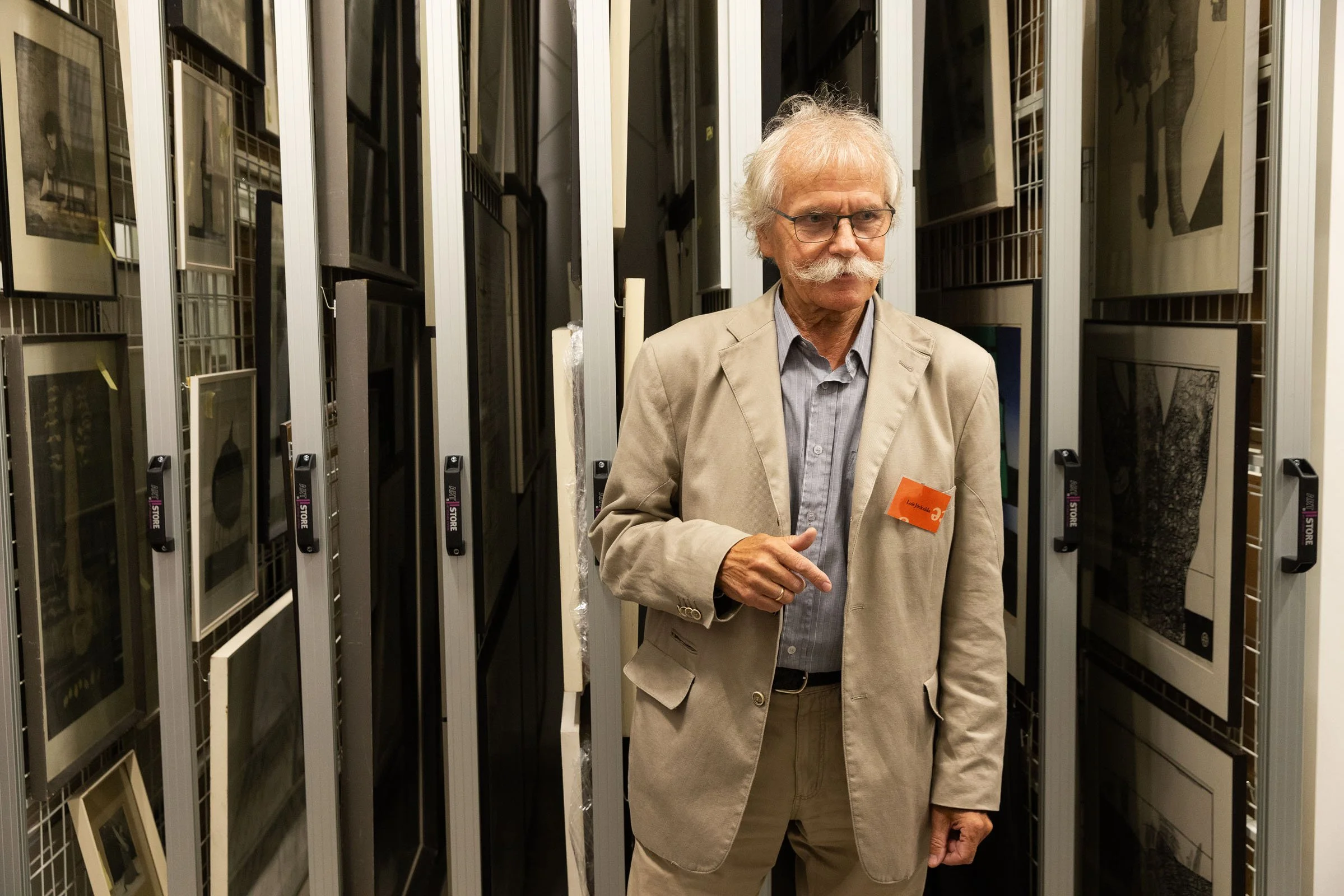
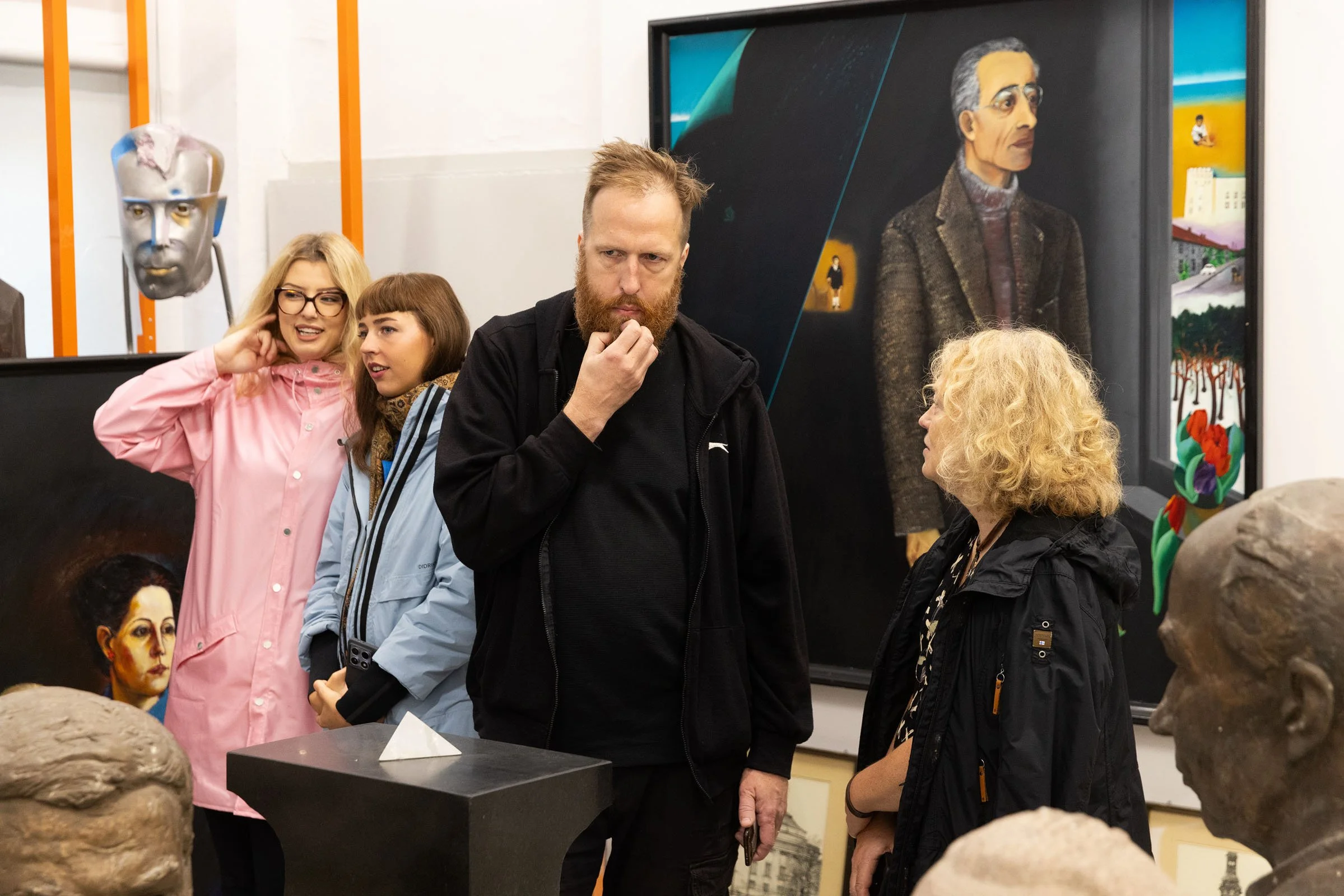
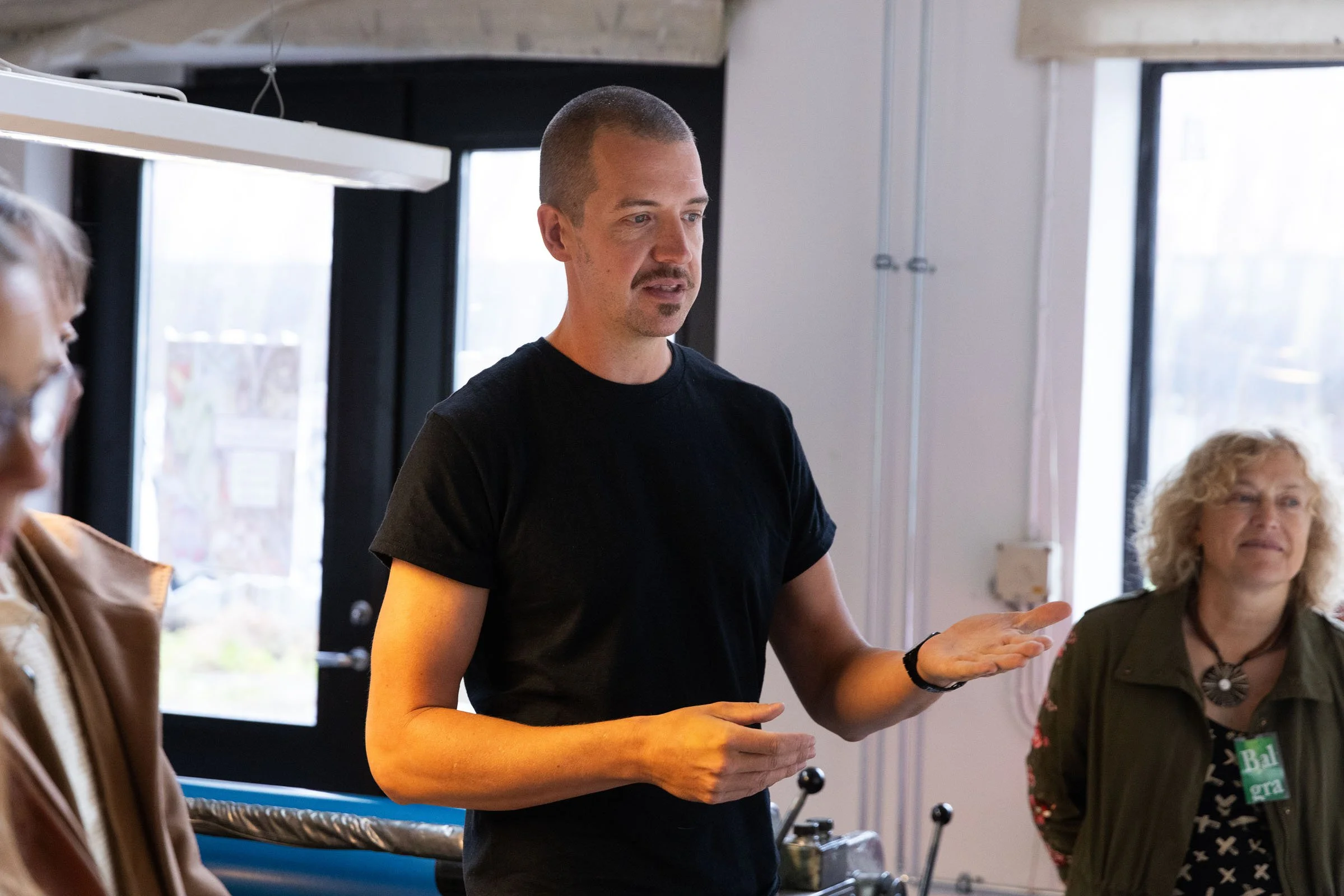
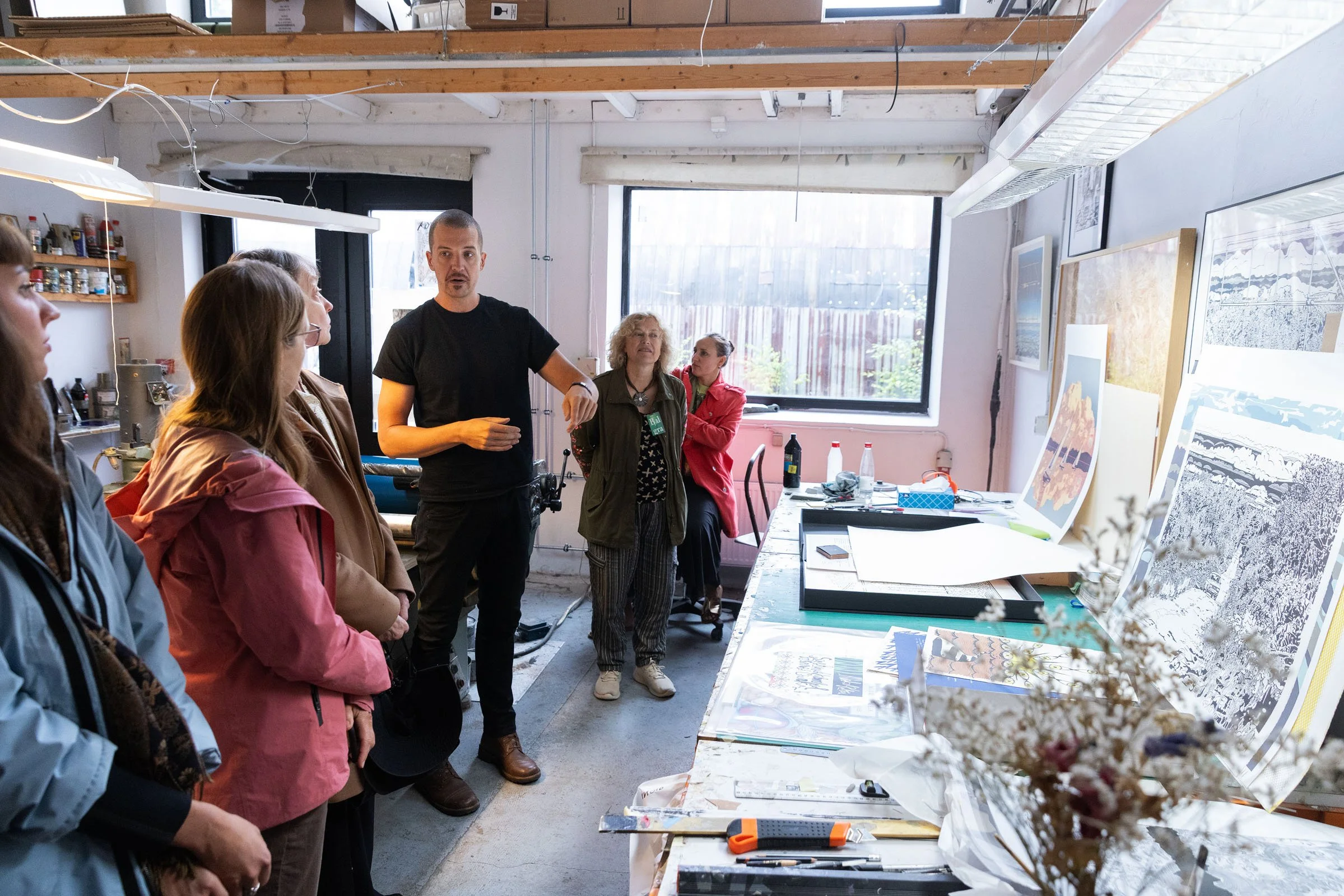
Fortunately, in Estonia, the summer offers a great opportunity for cooperation and communication, with the “Muhu Print” event held at the Nõmmküla art farm on Muhu Island, where colleagues invited from abroad introduce new techniques to Estonian artists. At the conference, Kadri Toom described the latest “Muhu Print” workshops, while Loit Jõekalda introduced the prints collection of the Estonian Artists’ Association. The participants also visited the Ubu Noir offset lithography workshop in the ARS Art Factory, where the master printmaker Lauri Koppel spoke about his work.
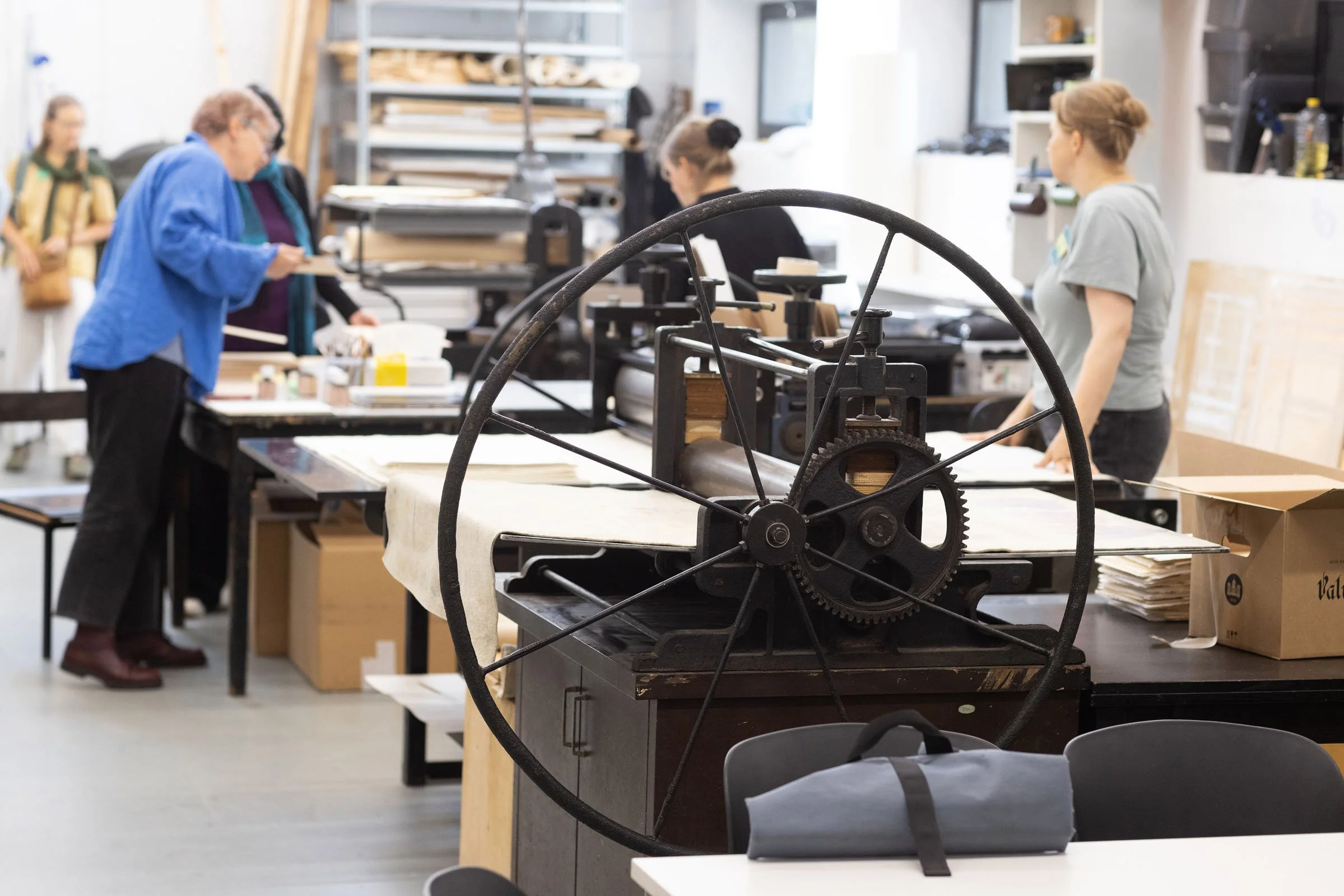
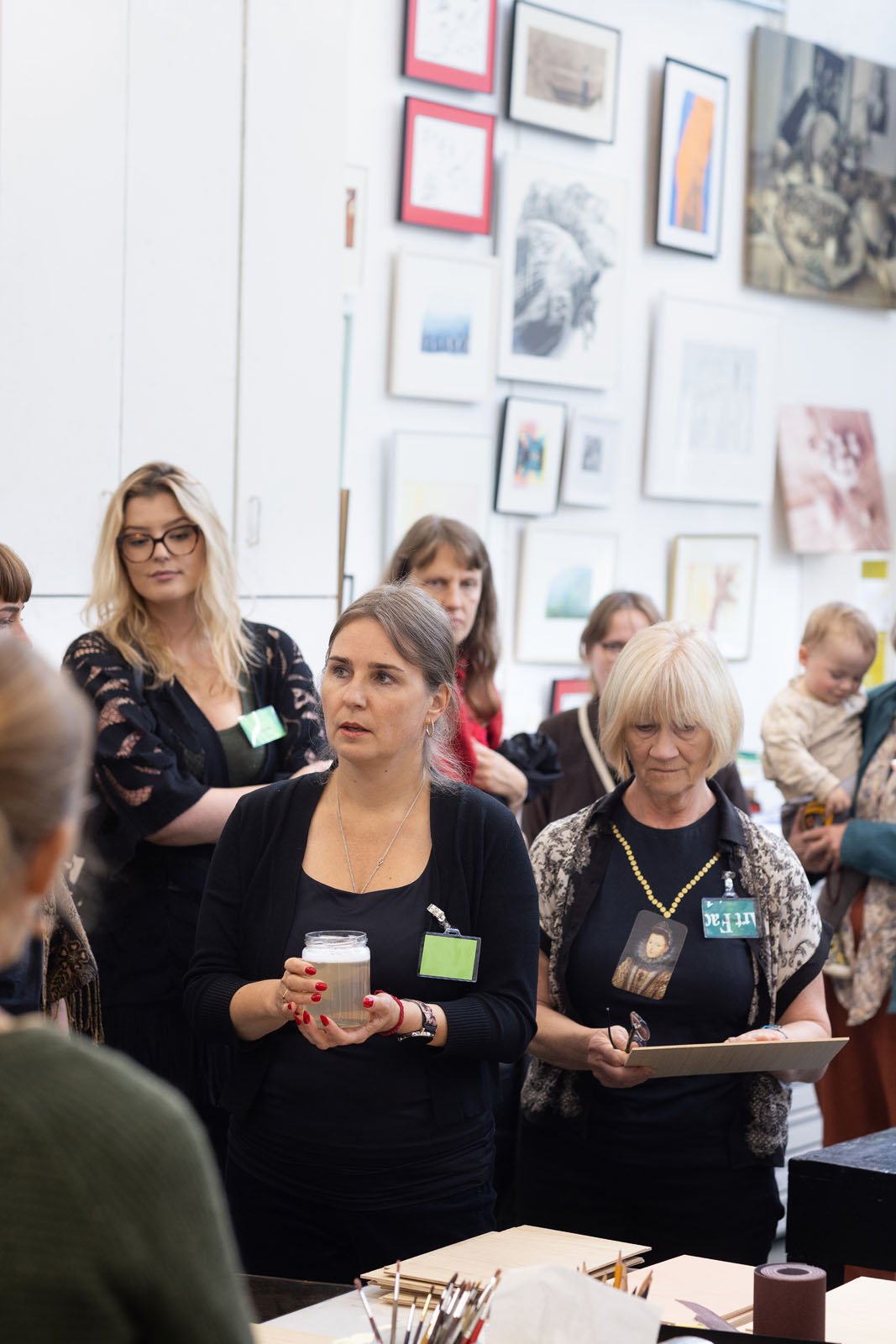
There is also the Graafika.ee studio and gallery in Tallinn, which has two intaglio presses and photopolymer equipment, and can produce works in eleven different techniques. The studio members Helen Tago and Kaija Kesa-Rebane organised a mokulito workshop for participants on the second day of the conference.
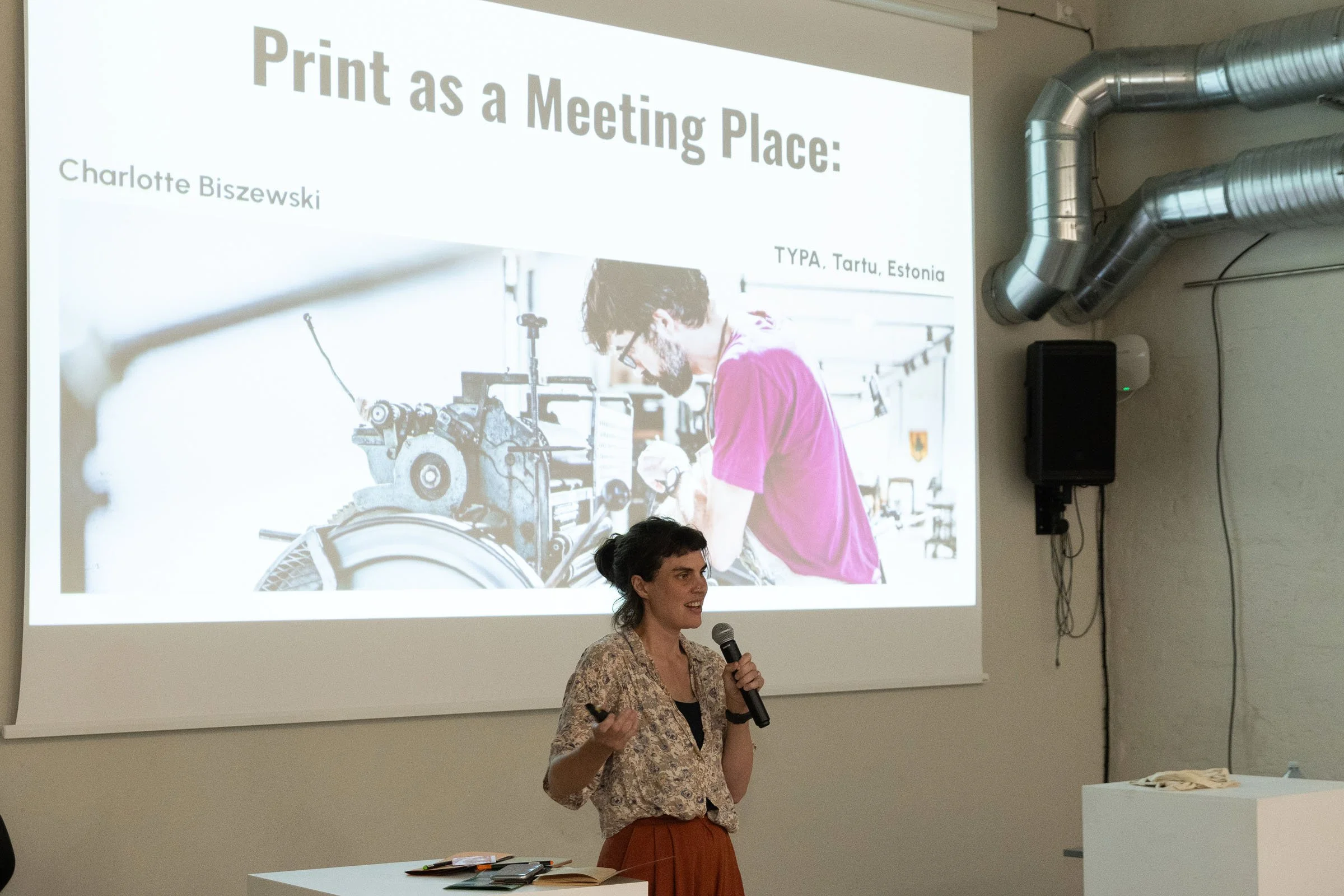
In Tartu, there is an opportunity to print graphics at the TYPA Printing and Paper Art Centre. Charlotte Biszewski, who works there, introduced their activities, which focus on the mechanical printing and graphic presses preserved in the museum, most of which are in working order, and their use. The centre’s work received the Ilucidare Award in 2020 for excellence in heritage-led innovation. TYPA is active in various areas: workshops, educational programmes, concerts, residencies, paper making, book readings etc. There is cooperation with educational institutions, artists and people interested in the history of printing. One interesting direction is cyanotype, i.e. photographs taken using ultraviolet radiation, and a printmaking technique based on them. The title of the presentation, “Printing as a Meeting Place”, refers to cooperation between people with various skills, the use of different printing techniques, and the study and repair of printing presses. Hopefully, the popularity of new printmaking venues in Estonia will grow over time and attract more participants, which will increase the creative activities of those who have studied printmaking.
The square and the horse
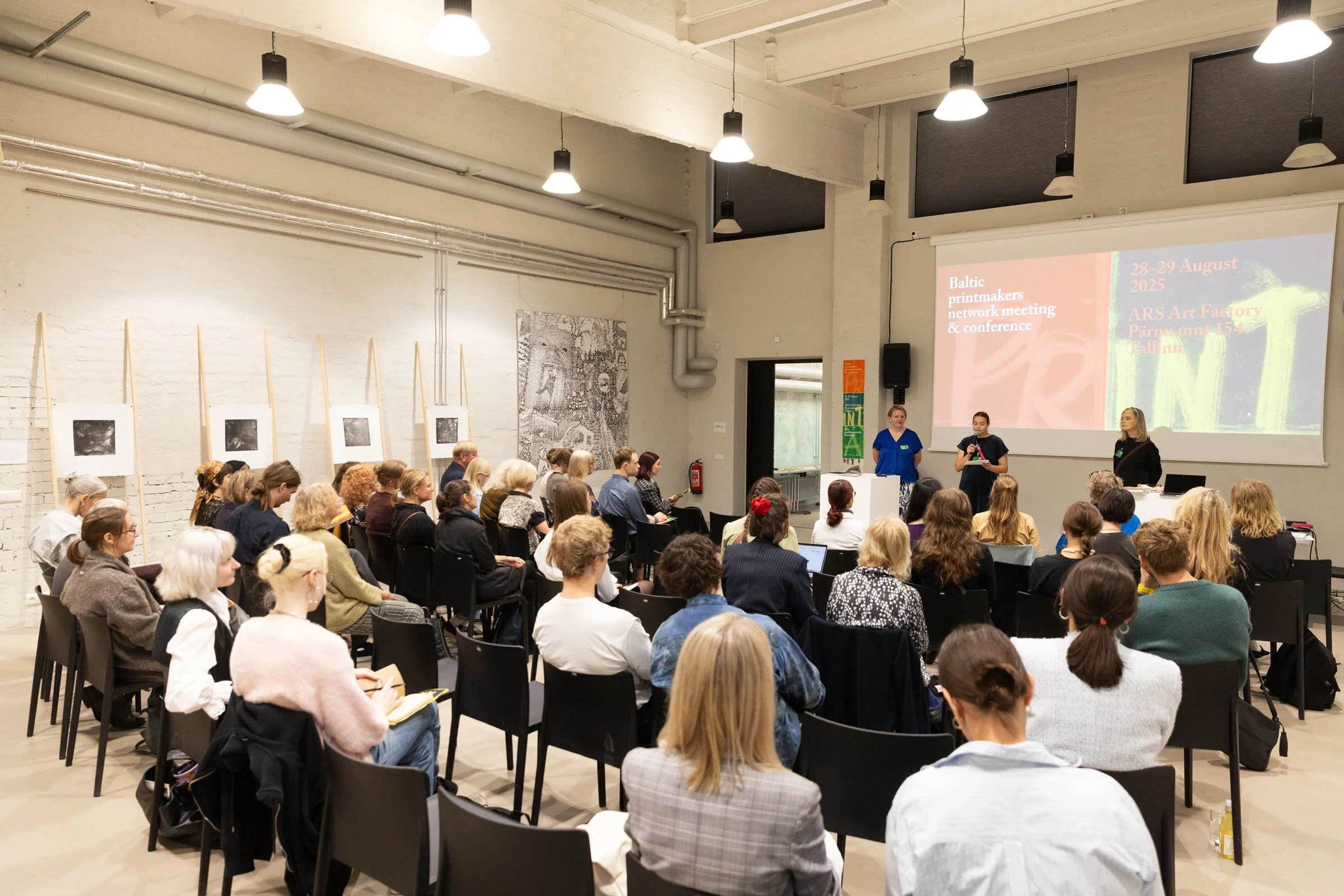
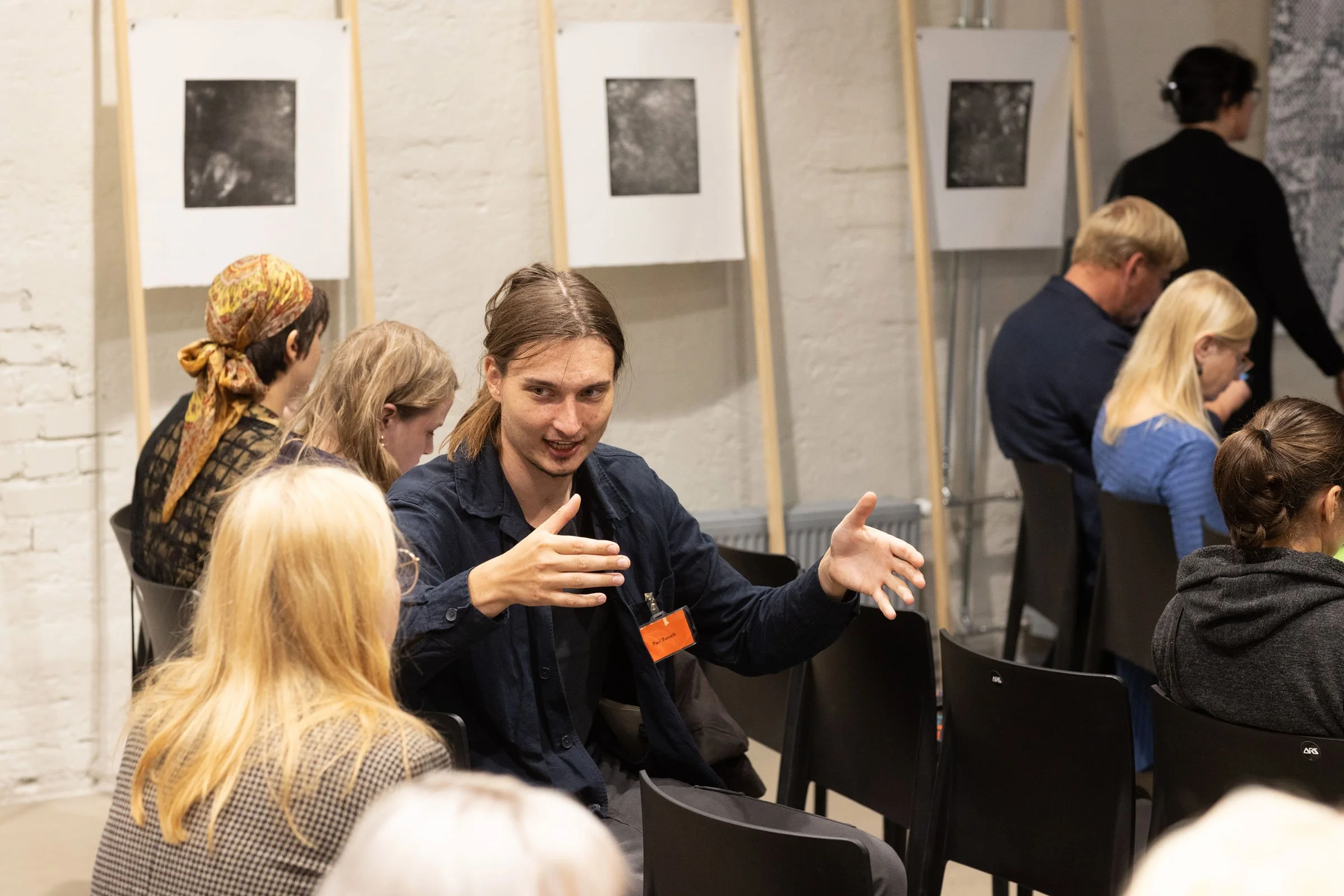
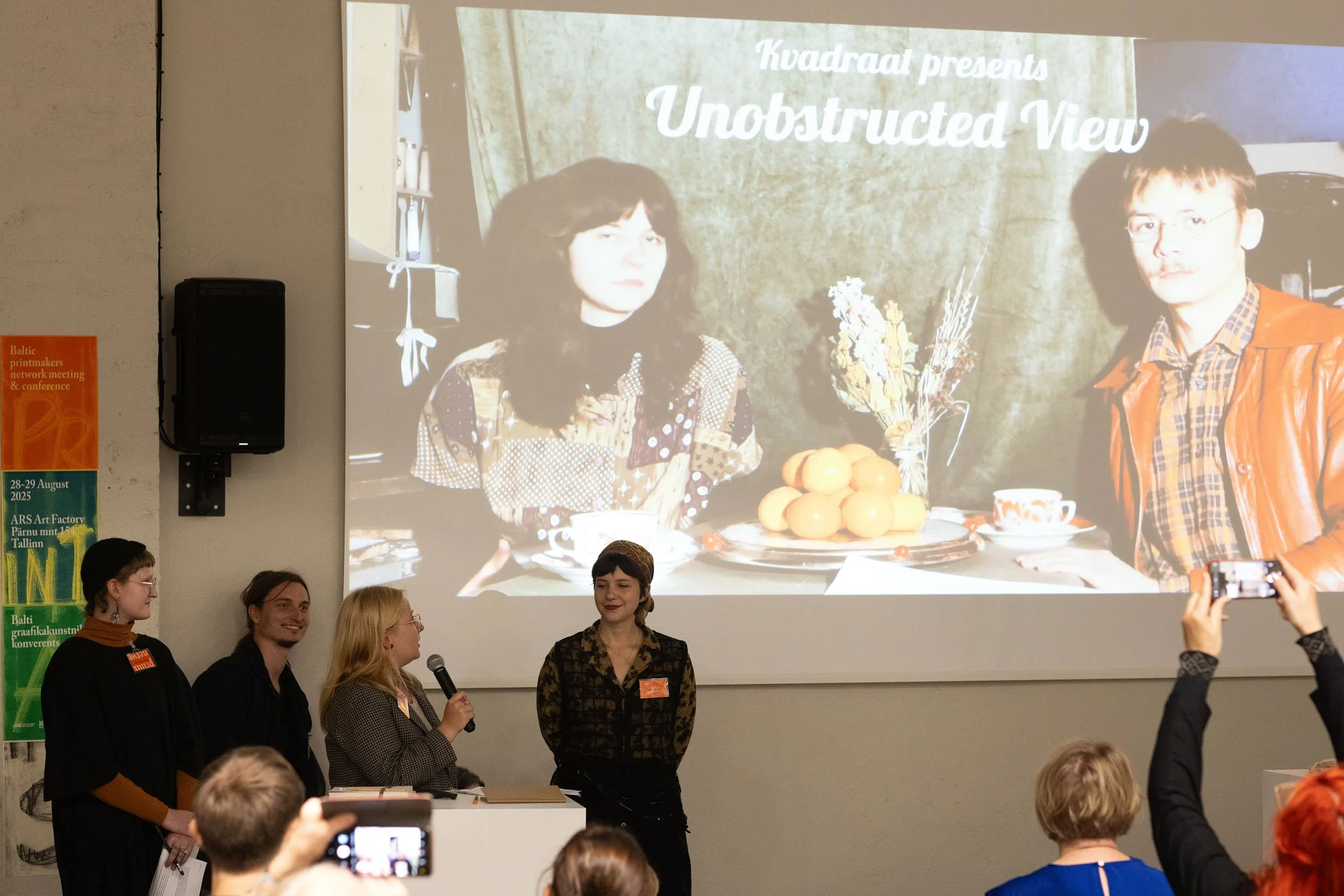
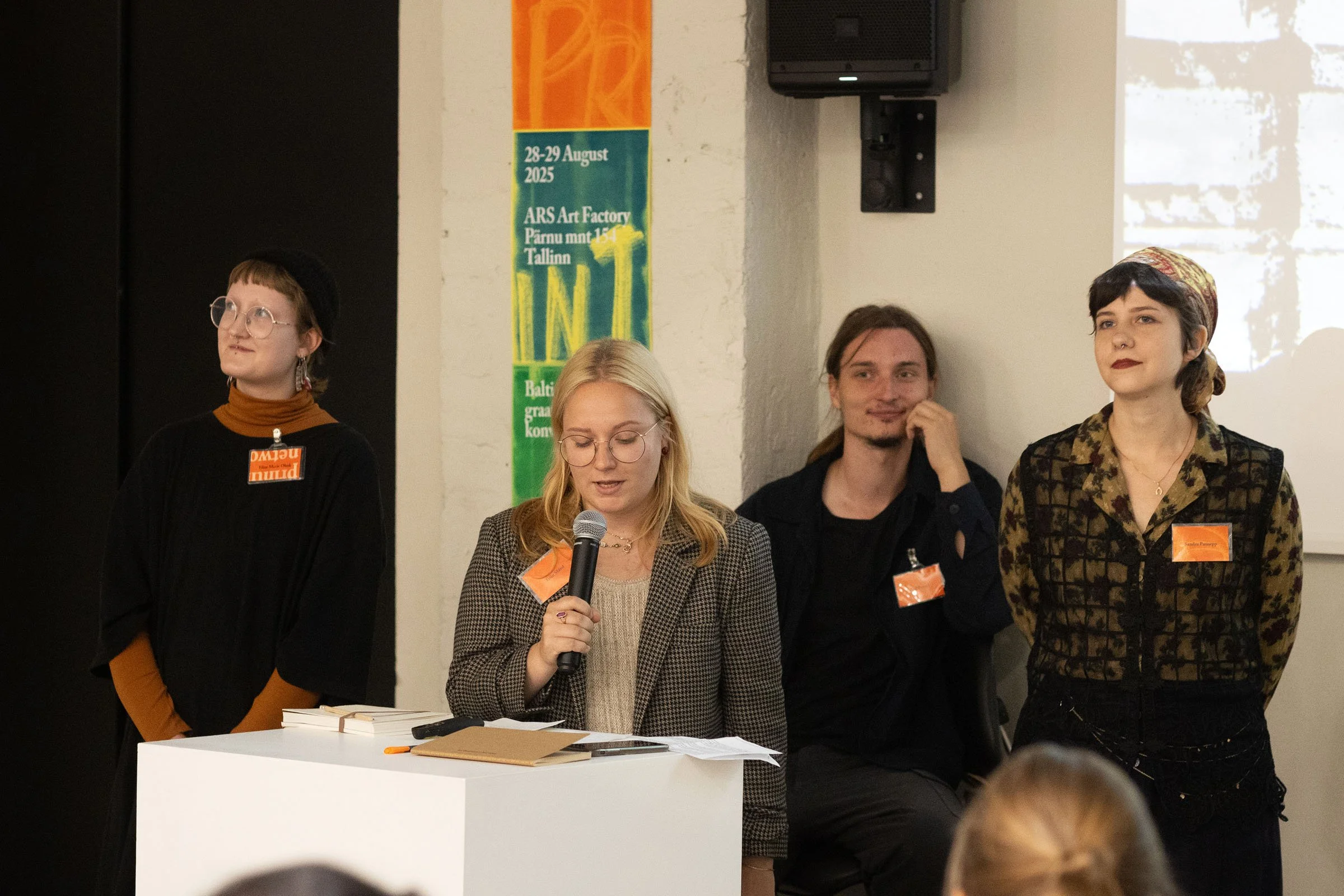
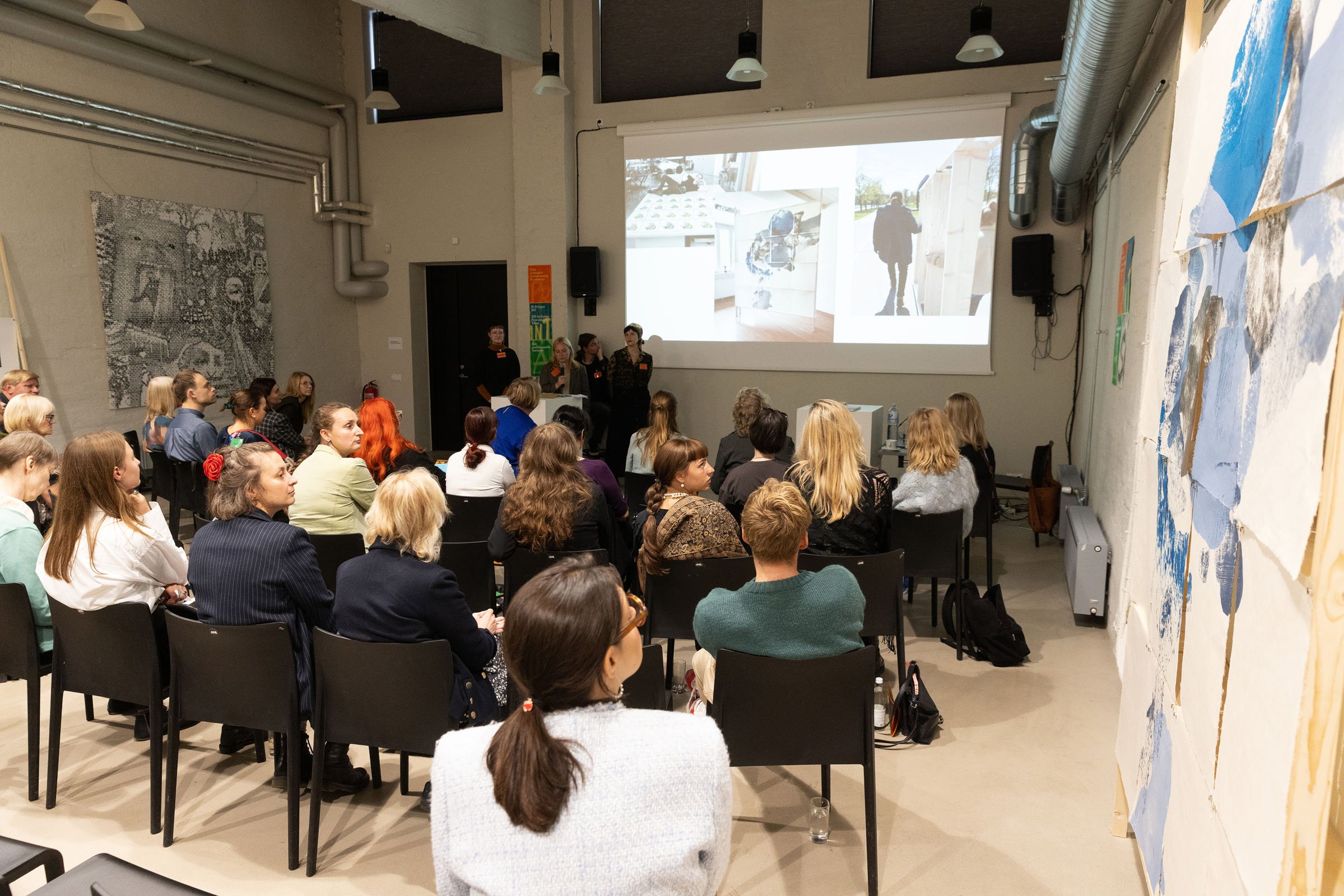
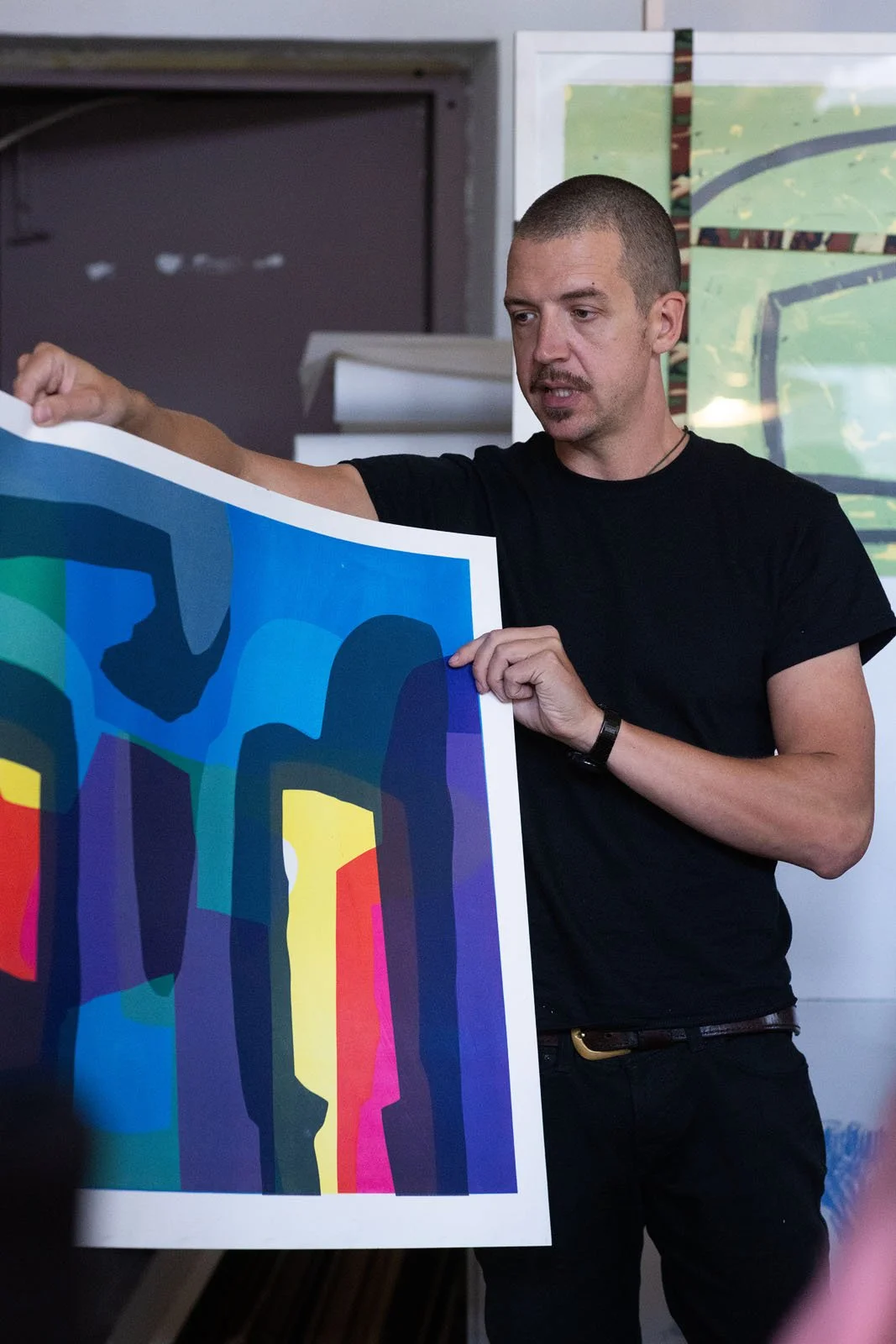
It was helpful that the conference organisers were also interested in the future of printmaking and had invited students from the Estonian and Vilnius art academies to speak. Each member of the Estonian art students group “Kvadraat” (“The Square”) spoke about their vision of printmaking, and this was illustrated by works exhibited in the conference room. Sandra Puusepp works with layering in lithography: colours that shine through each other give a unique quality to a lithograph. Paul Rannik is interested in achieving uniqueness in printmaking. His large-scale works are exhibited on numerous sheets, together forming images. Triin Mänd showed how sound can leave a harmonious mark on a printing plate without the intervention of a human hand. Martin Prei focuses on the material and the printing process when making graphic art, using a shifted raster-like effect in his digital works. The presentation also covered the group exhibitions of “Kvadraat” held in Kuressaare, the last of which took place this summer on the theme “As Nice as the Neighbour” and focused on collaboration and the mutual influence of artists.
In her presentation “A Horse in the Printmaking Department”, the Vilnius Academy of Arts student Gintautė Siniakovaitė spoke about her book design studies, e.g. how the same print can look different when it comes out of the press, and the type of randomness she and her fellow students used when publishing a poetry collection. One exciting undertaking was the drawing class “The Forms of Vilnius” by the graphic designer Sarah Boris. They also started publishing independently, took their prints to the Vilnius and Klaipėda book fairs, and organised the Ioannina Artbook and Zine Festival, which aimed to rethink artist books and book-objects as philosophical and aesthetic objects. A book fair was also held to support Ukraine and the students participated in the collaborative project “Mundane” with the graphic design students from the Klaipėda Department of the Vilnius Academy of Arts. By the end of each academic year, a nice pile of books was created, because the principle was: work like a horse!
The end is nigh
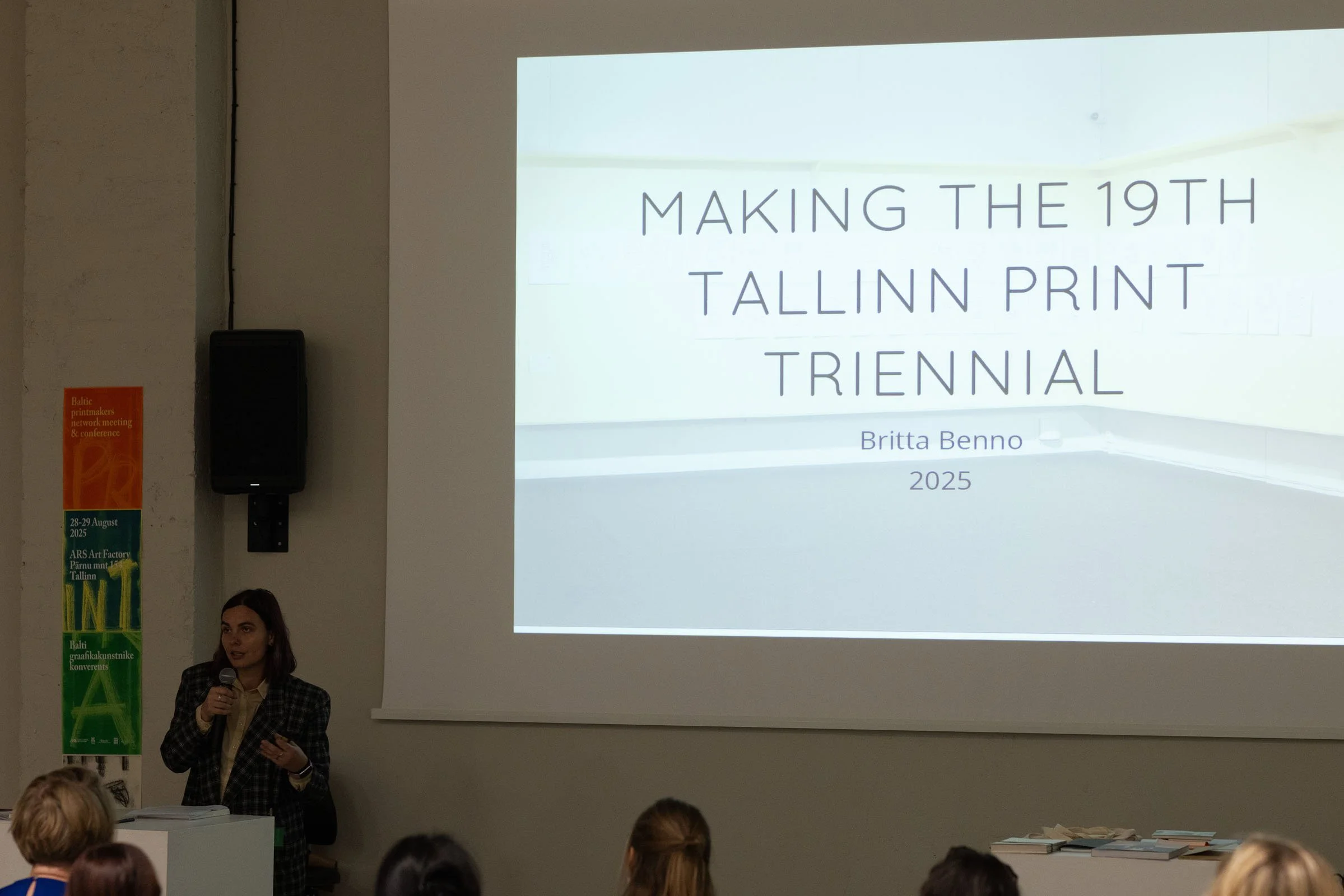
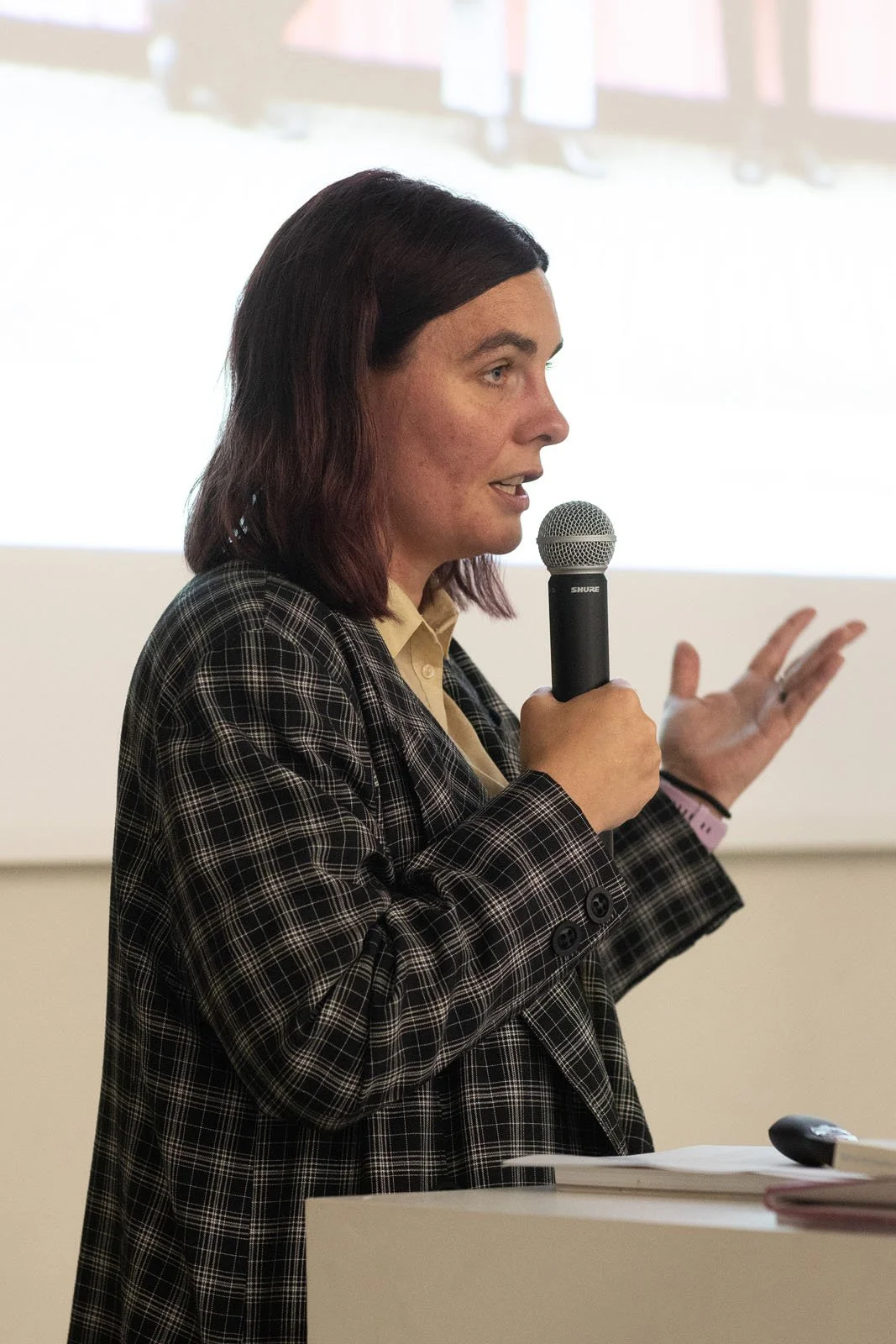
The organisers of the HUG conference collaborated with Tallinn Print Triennial XIX, which was in its final days, and invited the organisers of the exhibition to give presentations. As a result, the audience had the opportunity to attend a presentation by the curator of the triennial, Marika Agu, on the evening of the second day, where Agu introduced her concept2 at the exhibition in the Lasnamäe Pavilion of the Tallinn Art Hall. All of the conference participants were invited to take part in the closing ceremony of the triennial on the same day at the Lindakivi Cultural Center. In her presentation, Britta Benno talked about how the Print Triennial is organised, taking everybody behind the scenes of the exhibition. She introduced the team, described the meetings with selected artists and also talked about how the triennial’s (this time very unusual) logo was created. The triennial exhibition was designed by Maria Erikson and executed by Valge Kuup.
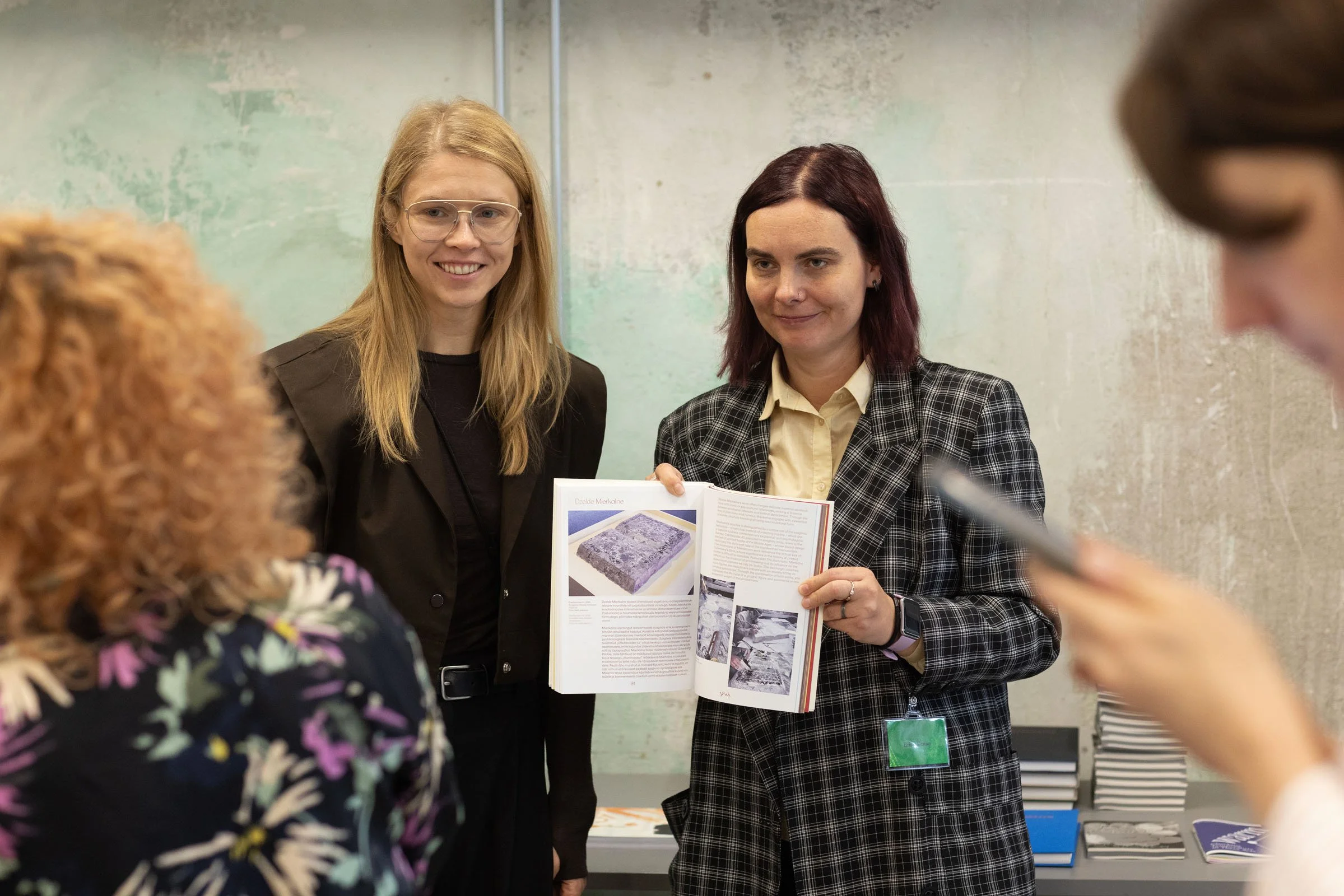
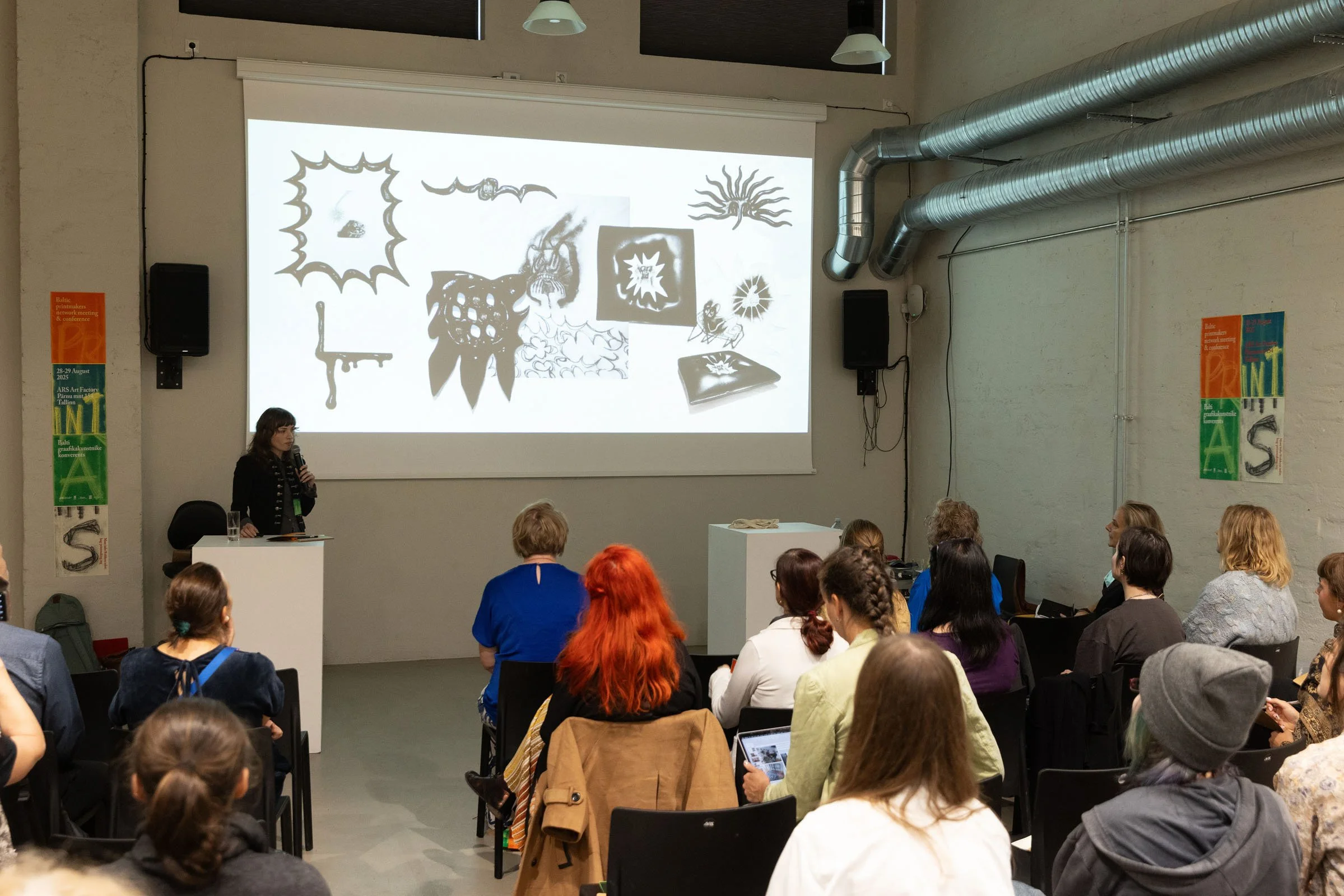
One of the triennial’s highlights was the work Etched in Dust. From Intaglio to Scagliola by the Latvian artist Dzelde Mierkalne, which stood right next to the entrance and was a good example of the changes in contemporary printmaking described above: it can be seen as both new and old. It also displays the logic of changes and the flights of fancy of the youngest artists, including curiosity spiked with irony. In her conference presentation, Mierkalne spoke captivatingly about the completion of the work. Intaglio in the title denotes intaglio printing, and scagliola is a finely structured plaster from which decorations imitating the marble inlay of beautiful Baroque interiors are made. This technique originated in Tuscany in the 17th century. Scagliola is made from plaster of Paris, glue and pigment, and imitates marble and other stone materials. (A pattern is engraved on the plaster surface using a matrix, then a special paint mixture is applied to the recesses, and the surface is polished with linseed oil and waxed to increase strength.)
Mierkalne also said that while working with intaglio, she was interested in imitation marble, which has a unique graphic appearance. In the 2021 series The End is Nigh, she began combining graphic techniques with sculptural or spatial drawing, addressing the theme of the end of the world and making cartoon characters act out with a certain irony the contradictory feelings and nightmares prevalent today. The artist learned the technique by observing classic works and experimenting independently. While applying for the Tallinn Print Triennial which had the theme of memory and media saturation, Mierkalne had the idea of making a copy of the Gutenberg Bible (1452–1454).
The first printed book in Western culture is, in a way, “guilty” of the emergence of later mass media, acting as a monument to our written culture. The artist modelled the exact form of this incunabula on a foam plastic base, and covered it with plaster. She engraved Gothic initials and acanthus leaf ornaments on the finished “bible”. When the completed work was polished with linseed oil, its surface felt silky, and the presenter recommended that when visiting the exhibition, the work should definitely be touched, which all the participants did with enthusiasm during their joint visit to the triennial the following day. Art has changed: sometimes touching an exhibit is advisable, because we experience art with other senses than sight.
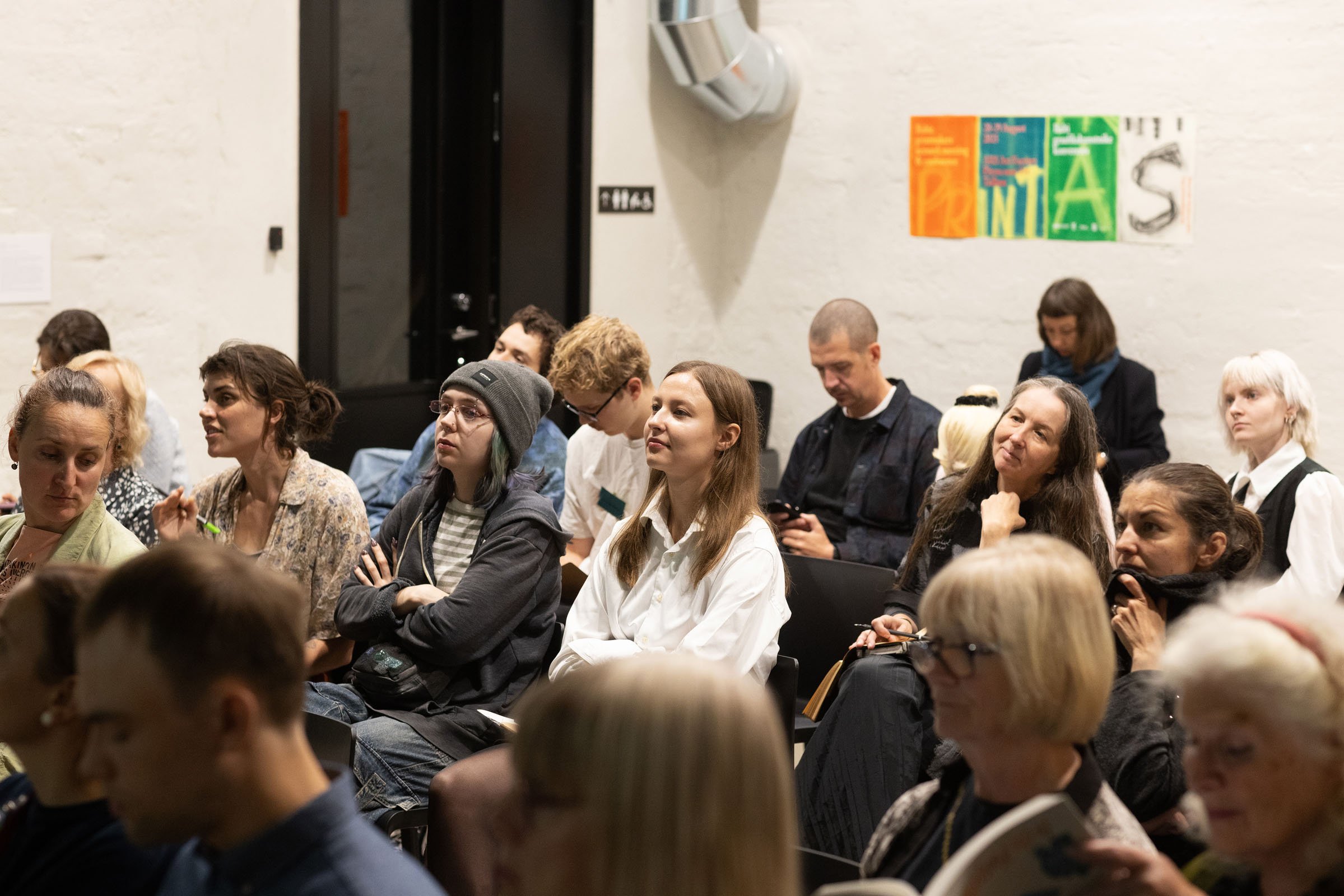
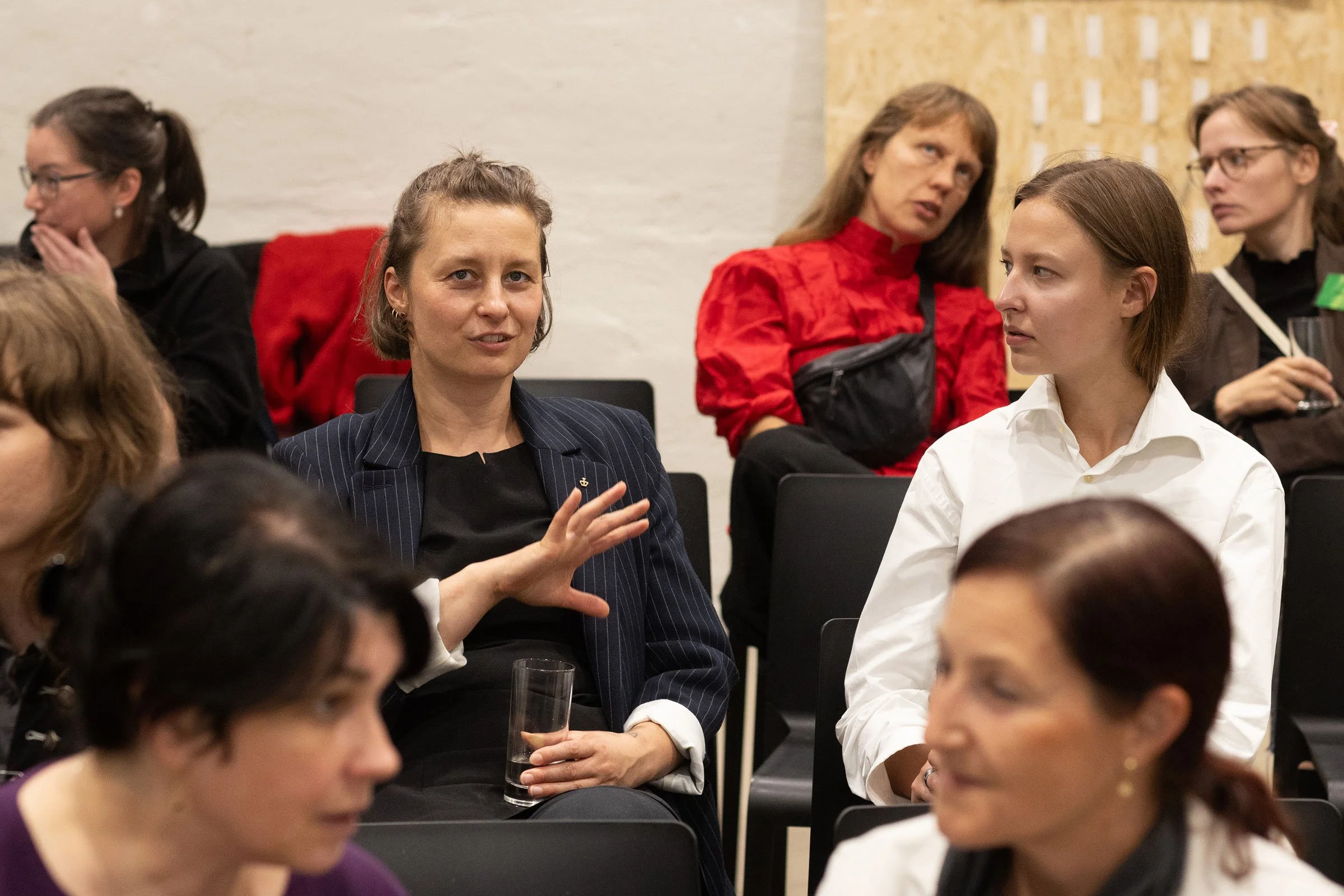
The discussion panel considered the future of printmaking in Estonia. It was stated that the HUG conference should definitely take place again in the future to make up for the limited communication and lack of information among graphic artists. Whether it will take place every one or two years depends on the opportunities. The importance of communication was emphasised, especially the kind that takes place face to face, rather than through the mediation of the internet. The more printmaking workshops, meetings, residencies etc. there are, the more creative work will be produced. The idea was also proposed that it would be good to have a support system that would help artists who have fallen into a creative vacuum for some reason (e.g. due to the birth of a child) return to printmaking.
It was a pleasure to see that among the attendees of the professionally organised conference were also employees of the Art Museum of Estonia, as well as lecturers and students of the Estonian Academy of Arts. The Estonian Artists’ Association supported the organisation and kindly rented the premises of the ARS Art Factory. Everybody left feeling good.
To end on an optimistic note: see you at the next conference!
1 See: https://estonianprintmakers.ee/
2 See the catalogue for Tallinn Print Triennial XI
BALTIC PRINTMAKERS NETWORK MEETING & CONFERENCE28.08–29.08.2025
We warmly invited printmakers, artists, and members of printmaking communities from across the Baltic region to join us for an inspiring gathering in Tallinn. This unique conference was dedicated to exploring the materiality of printmaking today and fostering dialogue within the vibrant Nordic–Baltic printmaking community.
Through insightful discussions and hands-on workshops, participants delved into environmentally conscious, sustainable, and non-toxic printmaking techniques. Together, we celebrated the distinctive qualities of printmaking processes and reflected on their role in shaping contemporary artistic practices, while addressing ecological responsibility within the field.
The event was organised by HUG, an initiative dedicated to developing and strengthening printmaking communities across the Nordic–Baltic countries.
Mokulito, Scagliola and Other Fruits of the Tree of Great New Printmaking
Over the past half century, the history of Estonian printmaking has been eventful. When the Tallinn Print Triennial was launched in 1968, our capital soon became a beacon in the art world of the Soviet Union, as we consciously oriented ourselves towards Western art, which distinguished us from the more traditional printmaking of Latvia, Lithuania and even more so from the other Soviet republics of the time. In 1989, the Print Triennial became an international event, but for a while longer, Estonian artists still had a fairly high chance of being selected for the triennial.
The triennial’s role as a driving force kept our art at a high level, because most artists worked very actively to prepare for the competition held every three years. There was a great sense of competitiveness within the Experimental Printmaking Studio – later the Printmaking Hall (Graafikakoda) – where colleagues would see each other’s works whether they wanted to or not. Working together provided a sense of support, catalogues received from abroad were passed round, and discussions on art topics were held. Such cooperation continued until the end of the 20th century and even into the beginning of the new millennium, although representatives of the older generation were becoming fewer and fewer. New graphic artists also emerged who considered themselves the students of the masters of the previous century.
But printmaking changes with time: not only printing techniques, but also colours, types of paper and technical tools. Conceptualism holds an elevated position in contemporary art, also influencing printmaking. Thus, graphic art is both new and old, because it is always associated with techniques. Graphic artists make printing plates, which are the cornerstones of their work. The prints from the plates themselves are (traditionally) considered artworks and are displayed at exhibitions.
The north and the south
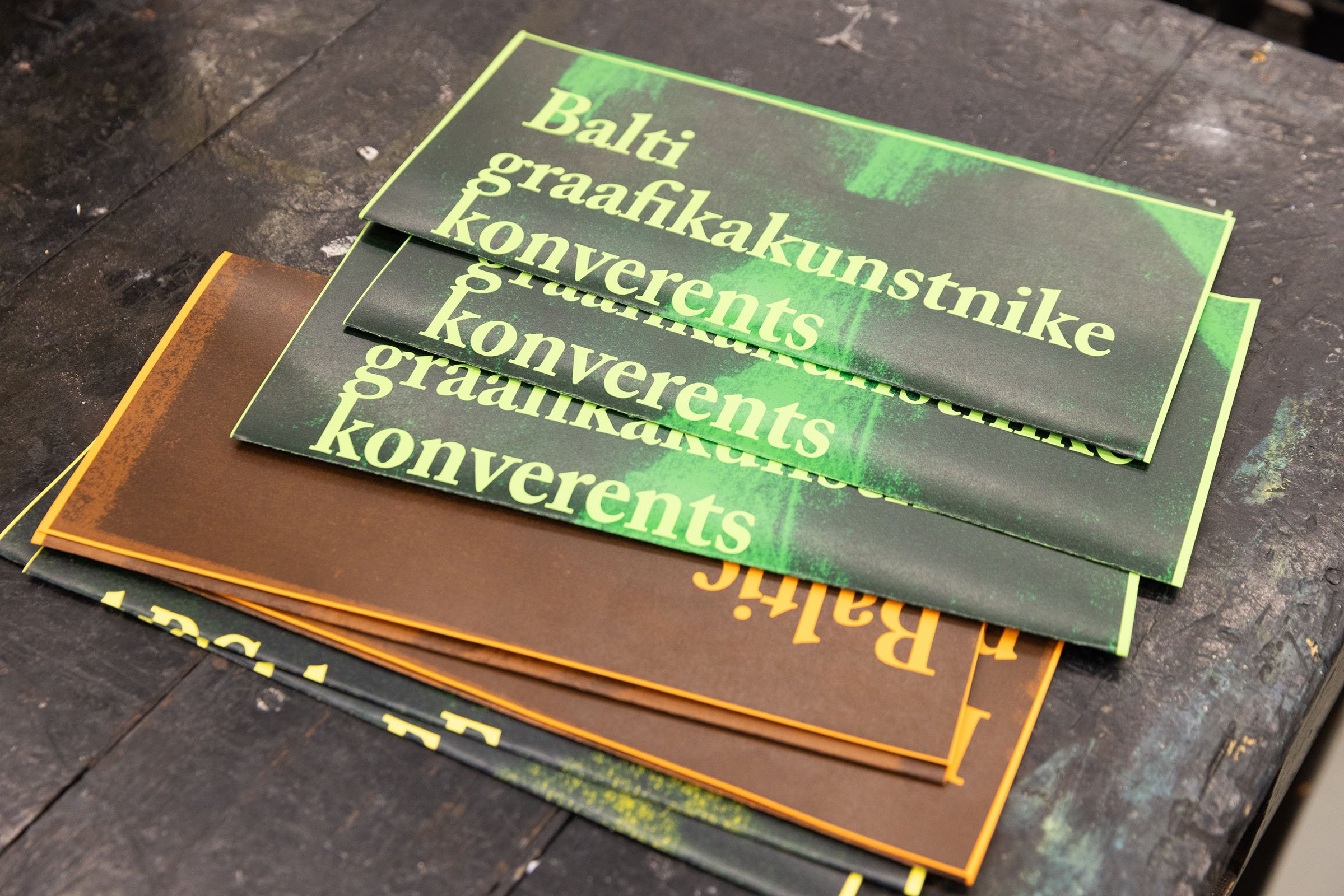
These changes, the current situation and the relationship between the new and the old were discussed at the conference “Print As” held on 28 and 29 August 2025 at the ARS Art Factory and organised by the NGO Hea Uus Graafika (abbreviated as HUG and translated as Great New Printmaking). Since the working language was English, the meaning of this abbreviation did not go unnoticed. The poster read: “Baltic printmakers network meeting & conference”. In addition to the Baltic countries, the Nordics were also involved, and they have played an important role as good cooperation partners for Estonian printmakers for decades. The initiators of this very necessary undertaking were the printmakers Liis Tedre, Kadri Toom and Lilli-Krõõt Repnau, all of whom were born about ten years after the first Print Triennial was organised.
Lene Leveau, the director of the Funen Printmaking Studio in Odense, Denmark, and the artist Kirsten Muchitch Hesselager were invited to speak at the conference, representing the Nordic countries. The Nordic Printmaking Network (Nordisk Grafik Union) was founded in 1910 with the aim of creating contacts between the artists of these countries and developing together. This grew into a dense network that now connects printmaking organisations operating in these countries. The speaker emphasised that the goal of the network’s activities is not profit, but voluntary work and good results in art. The member countries meet regularly, most recently in 2024 in Odense. Information and experiences are exchanged and knowledge about new techniques is shared. In the Nordic countries, graphic artists have many joint workshops. For example, in Sweden they are called artists’ collective workshops (konstnärnernas kollektivverkstäder). Odense also has a studio, a residency, a gallery and a shop. A very serious atmosphere has historically developed in this unique ecosystem.
In Lithuania, the heart of printmaking is the Vilnius Graphic Arts Centre (Vilniaus grafikos meno centras), whose active undertakings automatically make one think that Lithuanian printmakers are currently in a somewhat better situation than their Estonian colleagues, because the aim of this organisation is directly to support the activities of graphic artists in any way possible. The Lithuanians Jurga Minčinauskienė and Kristina Kleponytė-Šemeškienė spoke about exhibitions, participation in international cooperation projects, publishing catalogues, research-based art books and monographs, and art programmes for adults and children. The gallery Kaire-dešinė, which has been operating at the centre since 1995, organises curatorial and solo exhibitions, as well as shows about illustration, young artists and artist books by Lithuanian and foreign authors.
Drawing exhibitions by Lithuanian artists have been taking place since 2006. The presenters also circulated valuable publications among the public: for example, The Body. Graphic Art 1980–2013, Lithuanian posters during World War I and II, exhibition catalogues of drawings by the graphic artist Petras Repšys and the painter Povilas Ričardas Vaitekunas, monographs on the graphic designers Telesforas Kulakauskas and Antanas Kazakauskas, and on the illustrator Kestutis Kasparavičius, etc.
Ieva Naglina, the head of the Latvian Chamber of Graphics (Grafikas Kamera), similar to the Vilnius Graphic Arts Center, spoke about the institution she founded in the 1990s with the aim of helping artists during the transformations of the era, because they were facing commercial challenges. The Latvian Chamber of Graphics organises exhibitions, conferences, excursions to the Tallinn Print Triennial, etc. They also have their own Kammergalerija, where exhibitions of smaller prints have been held, e.g. by the Latvian artists Imants Krepics, Gundega Evelone, et al, as well as by the Finnish artist Niina-Anneli Kaarnamo, who studied at the Estonian Academy of Arts, and the Estonian Toomas Kuusing. Lectures are held and workshops are organised on graphic techniques and skills in using photography and computers. The Chamber’s prints collection was founded during the Soviet era.
A roof over your head?
Estonia currently does not have a supportive umbrella organisation as in the other Baltic countries. The Printmaking Hall is for actually printing works, but since the master printmaker is not present every day, a place for active communication, working and even drinking coffee together has disappeared. Works can only be displayed at the Eduard Wiiralt Art Award exhibition. The Print Triennial no longer offers our artists almost automatic participation. The activities of the Printmaking Hall and the Tallinn-based Association of Estonian Printmakers were introduced at the conference by Jaan Saar, the president of the association, and the board member Elle May Palumäe.1
Fortunately, in Estonia, the summer offers a great opportunity for cooperation and communication, with the “Muhu Print” event held at the Nõmmküla art farm on Muhu Island, where colleagues invited from abroad introduce new techniques to Estonian artists. At the conference, Kadri Toom described the latest “Muhu Print” workshops, while Loit Jõekalda introduced the prints collection of the Estonian Artists’ Association. The participants also visited the Ubu Noir offset lithography workshop in the ARS Art Factory, where the master printmaker Lauri Koppel spoke about his work.
There is also the Graafika.ee studio and gallery in Tallinn, which has two intaglio presses and photopolymer equipment, and can produce works in eleven different techniques. The studio members Helen Tago and Kaija Kesa-Rebane organised a mokulito workshop for participants on the second day of the conference.
In Tartu, there is an opportunity to print graphics at the TYPA Printing and Paper Art Centre. Charlotte Biszewski, who works there, introduced their activities, which focus on the mechanical printing and graphic presses preserved in the museum, most of which are in working order, and their use. The centre’s work received the Ilucidare Award in 2020 for excellence in heritage-led innovation. TYPA is active in various areas: workshops, educational programmes, concerts, residencies, paper making, book readings etc. There is cooperation with educational institutions, artists and people interested in the history of printing. One interesting direction is cyanotype, i.e. photographs taken using ultraviolet radiation, and a printmaking technique based on them. The title of the presentation, “Printing as a Meeting Place”, refers to cooperation between people with various skills, the use of different printing techniques, and the study and repair of printing presses. Hopefully, the popularity of new printmaking venues in Estonia will grow over time and attract more participants, which will increase the creative activities of those who have studied printmaking.
The square and the horse
It was helpful that the conference organisers were also interested in the future of printmaking and had invited students from the Estonian and Vilnius art academies to speak. Each member of the Estonian art students group “Kvadraat” (“The Square”) spoke about their vision of printmaking, and this was illustrated by works exhibited in the conference room. Sandra Puusepp works with layering in lithography: colours that shine through each other give a unique quality to a lithograph. Paul Rannik is interested in achieving uniqueness in printmaking. His large-scale works are exhibited on numerous sheets, together forming images. Triin Mänd showed how sound can leave a harmonious mark on a printing plate without the intervention of a human hand. Martin Prei focuses on the material and the printing process when making graphic art, using a shifted raster-like effect in his digital works. The presentation also covered the group exhibitions of “Kvadraat” held in Kuressaare, the last of which took place this summer on the theme “As Nice as the Neighbour” and focused on collaboration and the mutual influence of artists.
In her presentation “A Horse in the Printmaking Department”, the Vilnius Academy of Arts student Gintautė Siniakovaitė spoke about her book design studies, e.g. how the same print can look different when it comes out of the press, and the type of randomness she and her fellow students used when publishing a poetry collection. One exciting undertaking was the drawing class “The Forms of Vilnius” by the graphic designer Sarah Boris. They also started publishing independently, took their prints to the Vilnius and Klaipėda book fairs, and organised the Ioannina Artbook and Zine Festival, which aimed to rethink artist books and book-objects as philosophical and aesthetic objects. A book fair was also held to support Ukraine and the students participated in the collaborative project “Mundane” with the graphic design students from the Klaipėda Department of the Vilnius Academy of Arts. By the end of each academic year, a nice pile of books was created, because the principle was: work like a horse!
The end is nigh
The organisers of the HUG conference collaborated with Tallinn Print Triennial XIX, which was in its final days, and invited the organisers of the exhibition to give presentations. As a result, the audience had the opportunity to attend a presentation by the curator of the triennial, Marika Agu, on the evening of the second day, where Agu introduced her concept2 at the exhibition in the Lasnamäe Pavilion of the Tallinn Art Hall. All of the conference participants were invited to take part in the closing ceremony of the triennial on the same day at the Lindakivi Cultural Center. In her presentation, Britta Benno talked about how the Print Triennial is organised, taking everybody behind the scenes of the exhibition. She introduced the team, described the meetings with selected artists and also talked about how the triennial’s (this time very unusual) logo was created. The triennial exhibition was designed by Maria Erikson and executed by Valge Kuup.
One of the triennial’s highlights was the work Etched in Dust. From Intaglio to Scagliola by the Latvian artist Dzelde Mierkalne, which stood right next to the entrance and was a good example of the changes in contemporary printmaking described above: it can be seen as both new and old. It also displays the logic of changes and the flights of fancy of the youngest artists, including curiosity spiked with irony. In her conference presentation, Mierkalne spoke captivatingly about the completion of the work. Intaglio in the title denotes intaglio printing, and scagliola is a finely structured plaster from which decorations imitating the marble inlay of beautiful Baroque interiors are made. This technique originated in Tuscany in the 17th century. Scagliola is made from plaster of Paris, glue and pigment, and imitates marble and other stone materials. (A pattern is engraved on the plaster surface using a matrix, then a special paint mixture is applied to the recesses, and the surface is polished with linseed oil and waxed to increase strength.)
Mierkalne also said that while working with intaglio, she was interested in imitation marble, which has a unique graphic appearance. In the 2021 series The End is Nigh, she began combining graphic techniques with sculptural or spatial drawing, addressing the theme of the end of the world and making cartoon characters act out with a certain irony the contradictory feelings and nightmares prevalent today. The artist learned the technique by observing classic works and experimenting independently. While applying for the Tallinn Print Triennial which had the theme of memory and media saturation, Mierkalne had the idea of making a copy of the Gutenberg Bible (1452–1454).
The first printed book in Western culture is, in a way, “guilty” of the emergence of later mass media, acting as a monument to our written culture. The artist modelled the exact form of this incunabula on a foam plastic base, and covered it with plaster. She engraved Gothic initials and acanthus leaf ornaments on the finished “bible”. When the completed work was polished with linseed oil, its surface felt silky, and the presenter recommended that when visiting the exhibition, the work should definitely be touched, which all the participants did with enthusiasm during their joint visit to the triennial the following day. Art has changed: sometimes touching an exhibit is advisable, because we experience art with other senses than sight.
The discussion panel considered the future of printmaking in Estonia. It was stated that the HUG conference should definitely take place again in the future to make up for the limited communication and lack of information among graphic artists. Whether it will take place every one or two years depends on the opportunities. The importance of communication was emphasised, especially the kind that takes place face to face, rather than through the mediation of the internet. The more printmaking workshops, meetings, residencies etc. there are, the more creative work will be produced. The idea was also proposed that it would be good to have a support system that would help artists who have fallen into a creative vacuum for some reason (e.g. due to the birth of a child) return to printmaking.
It was a pleasure to see that among the attendees of the professionally organised conference were also employees of the Art Museum of Estonia, as well as lecturers and students of the Estonian Academy of Arts. The Estonian Artists’ Association supported the organisation and kindly rented the premises of the ARS Art Factory. Everybody left feeling good.
To end on an optimistic note: see you at the next conference!
1 See: https://estonianprintmakers.ee/
2 See the catalogue for Tallinn Print Triennial XI
Partners:
Association of Estonian Printmakers
Funen Printmaking Studio
graafika.ee
Grafikas Kamera
Graphic Art department / EKA
Graphic Design department / EKA
Tallinn Print Triennial
TYPA
Vilnius Academy of Arts
Vilnius Graphic Art Centre
Supported by:
ARS Art Factory
Estonian Artists Association
Cultural Endowment of Estonia
Estonian Ministry of Culture
Mertopol Spa Hotell
Acconto Baltics OÜ
Skizze.ee